



Our planet is threatened by the triple planetary health crisis consisting of climate change, biodiversity loss, and pollution. This crisis is impacting on the health and wellbeing of humans and the planet. As a result, there has been an increasing call for health professionals to be educated about planetary and global health. To respond to this call, two guides, the Planetary Health Education Framework (PHEF), and the Global Health Education Competencies Tool-Kit can support nurse educators and educators in other disciplines to meaningfully embed and transform curricula by introducing planetary and global health content.
Currently, our planet is threatened by the triple planetary crisis which consists of climate change, biodiversity loss, and pollution (United Nations [UN], 2022). As a result, there has been an increasing call for health professionals to integrate planetary health concepts in their curricula through transdisciplinary education and systems thinking (Potter, 2026). This article highlights two guides, the Planetary Health Education Framework ([PHEF]; Faerron-Guzmán & Potter, 2021a; Faerron-Guzmán et al., 2021b), and the Consortium of Universities in Global Health (CUGH) Global Health Education Competencies Tool-Kit (Moore et al., 2024). These guides explore how to support and facilitate nurse educators in meaningful integration and transformation of planetary and global health content into nursing curricula.
...there has been an increasing call for health professionals to integrate planetary health concepts in their curricula...
First, a historical overview of the rationale for developing these guides is described. This is followed by a discussion of the call to meaningfully integrate planetary and global health education into nursing curricula. Ultimately, this will foster planetary and global health citizens to address the ongoing planetary and global health crisis. I conclude with examples that illustrate the application of these two guides in curricula for undergraduate and graduate nursing programs at a Canadian university. This Canadian exemplar is intended to support nurse educators and educators in other disciplines as they envision how these frameworks may be applied to integrate planetary and global health concepts into their curricula and thus benefit student learning.
Brief Historical Overview
Defining Planetary Health
Since 2003, the Stockholm Resilience Centre, has critically monitored Planetary Boundaries (PBs) which regulate safe operating space for humanity. These boundaries are biosphere integrity, climate change, novel entities, stratospheric ozone depletion, atmospheric aerosol loading, ocean acidification, biogeochemical flows, freshwater change, and land system change (Rockström et al., 2009). Over time, many PBs have been transgressed, or have been pushed beyond a safe, stable operating limit. For example, the boundary of ocean acidification was crossed in September 2025, leading to an irreversible tipping point resulting in permanent shifts in planet climate, biosphere, and other PBs (Stockholm Resilience Centre, 2026).
Over time, many PBs have been transgressed, or have been pushed beyond a safe, stable operating limit.
The Lancet Health Commission has declared that climate change is the greatest threat to health (Costello et al. 2009). In 2015, the Rockefeller-Lancet Commission of Planetary Health defined planetary health from an anthropocentric lens as “the achievement of the highest attainable standard of health, well-being, and equity worldwide through judicious attention to human systems – political, economic, and social-that shape the future of humanity and the Earth’s natural systems, that define the safe environmental limits within which humanity flourish” (Whitmee et al., 2015, p. 1974). This definition was pivotal in the planetary health movement. During this period, in 2015, other significant milestones were the landmark Paris Agreement, which adopted a commitment from 196 parties of the UN Climate Change Conference (UN, n.d.a), and the United Nations (UN., n.d.b) Sustainable Development Goals (SDGs) which align with planetary health.
This definition was pivotal in the planetary health movement.
Planetary Health and Health Education
In 2016, the Planetary Health Alliance (PHA, n.d.b) was founded, a consortium of approximately 550 universities, non-governmental organizations (NGOs), research institutes, and government entities from over 80 countries addressing environmental degradation to human health and the planet. There was ongoing acknowledgment that the world was experiencing increasingly catastrophic environmental events, such as droughts, wildfires, and extreme weather caused by fluctuations in temperatures, and atmospheric heat domes. Health educators were challenged to critically examine how concepts such as Planetary Health could be integrated into curricula to address our shared accountability and responsibility to preserve the health and well-being of humans, and the planet.
In 2018, the PHA developed a set of cross-cutting principles to guide curriculum for educators teaching planetary health (Stone et al, 2018). In addition, there was a convening of the inVIVO Planetary Health network in Canmore, Alberta, Canada where leaders set forth a planetary health research agenda focusing on the wellness of humankind and the vitality of the Earth’s natural systems (Precott et al., 2018). This group pledged to support the Ottawa Charter and principles which have been termed planetary health. During this network meeting, Dr. Nicole Redvers (member of the Deninu K’ue First Nation; NWT, Canada) worked with the group, noting that indigenous voices were missing in the focus on relevancy to human well-being. Dr. Redvers was able to open the dialogue to highlight the deep interconnectivity of people and planetary health (Richard & Astle, 2024). She was able to provide contributions to the principles and had continued work to promote the inclusion of indigenous perspectives of the interconnectedness of human and planetary health practice and research. Stemming from the 2015 definition above, the PHA (n.d.a) then defined planetary health as “a solutions-oriented, transdisciplinary field and social movement focused on analyzing and addressing the impacts of human disruptions to Earth’s natural systems on human health and all life on Earth” (para. 1), inclusive of all earth’s inhabitants and focusing on human health.
Planetary Health Education Framework
From 2019 to 2021, a group of thought leaders in planetary health and education undertook the task of creating an education framework to address the gap of a cohesive framework to guide educators, institutions, and learners about Planetary Health. The work of this group culminated in a Planetary Health Education Framework (PHEF) consisting of five domains considered foundational to the essence of planetary health values, knowledge, and practice. This framework (see the Figure) provided a shared language through a transdisciplinary educational lens (Faerron Guzmán & Potter, et al., 2021a).
Figure. Planetary Health Education Framework.
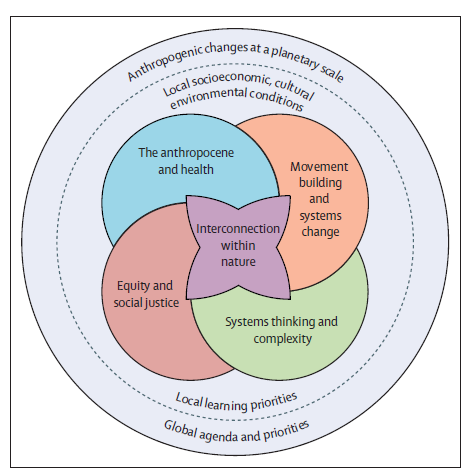
Source: Faerron-Guzmán et al. (2021, p. e253). Used under Creative Commons licence CC BY-NC-ND 5.0. Image used with permission of the Planetary Health Alliance
This framework provided a shared language through a transdisciplinary educational lens
The first domain in the framework, interconnection with nature, acknowledges diverse spiritual and diverse knowledge, particularly of Indigenous peoples who educate about deep interconnectedness to nature. The second domain, the Anthropocene and health, focuses on understanding the connections between health and the Anthropocene which requires a “social and ecological approach to health promotion and disease prevention and control, ranging from individual to population determinants of humans, animal, and the ecosystem of health” (Faerron-Guzmán et al, 2021b, p. 2). The third domain, systems thinking and complexity, focuses on the importance for learners to acknowledge and understand a self-awareness of their own biases and epistemological groundings. The fourth domain, equity, and justice, acknowledges that to achieve full vitality requires ensuring the rights of nature, humans, ecosystems, and that human populations are given the opportunity to thrive. The fifth domain, movement building and system change, addresses the importance of inclusive relationships that foster action toward future professionals and learners to “build effective movements to support systems change and the great transition of the future” (Faerron-Guzmán et al., 2021b, p. 2).
It is important to highlight that the domains are not hierarchical or sequential, but intertwined into one whole...
It is important to highlight that the domains are not hierarchical or sequential, but intertwined into one whole, much like the cross-section of a rope which cannot be separated. In addition, the operationalization of the PHEF depends on a specific learning context rather than being prescribed. The implementation of the framework is expected to vary across disciplines and educational contexts.
Global Health Education Competencies Tool-Kit
The Consortium of Universities for Global Health (CUGH) is an organization involved in higher education and global health. With the rapid expansion of global health programs, in 2008, at the inaugural meeting of CUGH, there was a discussion by the participants about the lack of standardized curricula and competencies to guide these programs. In 2015, the CUGH Competency Sub-Committee, alongside international collaborators, published a seminal article that identified interprofessional global health competencies for health professionals. These competencies described two levels, the basic operational program, and the global citizen level. Stemming from this work, was the development of the Global Health Education Competency Tool-Kit which included learning objectives and curricular content to support health educator in teaching these competencies. The CUGH Global Health Education Competency Toolkit is now in its 3rd edition (Moore et al., 2024). The most recent addition of the planetary health competency is now composed of 14 Domains, as follows:
- Global Burden of Disease
- Globalization of Health and Health Care
- Social and Environmental Determinants of Health
- Capacity Strengthening
- Collaboration, Partnering, and Communication
- Ethics
- Professional Practice
- Health Equity and Social Justice
- Program Management
- Sociocultural and Political Awareness
- Strategic Analysis
- Institutional and Sustainable Development
- Planetary Health (Decolonizing Global Health and Equitable Global Health Partnerships)
- Decolonizing Global Health.
The developers of this tool-kit emphasize that this is a living document and not a definitive, comprehensive resource; it is constantly evolving.
These competencies described two levels, the basic operational program, and the global citizen level.
A Call for Integration of Planetary Health in Nursing Curricula and other Disciplines
Since planetary health has emerged, there has been an increasing global call for action to integrate this concept in nursing curricula (Astle, 2024; Astle & Richard, 2024; Bonnamy et al., 2024; LeClair et al., 2024; Martin et al., 2024; Potter, 2021; Potter et. al., 2025; Ross & Speirs, 2024; Tutticci et al., 2024; Vandenberg, 2023; Ward et al., 2024). However, there is a gap in nursing literature as to how planetary health is integrated into nursing curricula. Vandenberg et al., (2025) conducted a scoping review to map the extent that the term planetary health was used in peer-reviewed nursing literature. They found that while there are many calls to action, there is a need to publish the work that nurses are doing in planetary health to specifically address nursing education, leadership, practice, and research. Similarly, as planetary health is transdisciplinary, other academic educators have been exploring ways in which to integrate planetary health education within their curricula (Addison et al., 2025; Potter, 2026; Redvers et al., 2023).
...while there are many calls to action, there is a need to publish the work that nurses are doing in planetary health...
While planetary health courses are continually emerging, there is also a gap in understanding the specific state of planetary health education in nursing (Astle et al, 2025) and other disciplines (Carrion et al., 2025). Astle et al. (2025), in a survey of Canadian schools of nursing, explored the integration of Planetary Health in nursing curricula and pedagogical practices. They found that the content taught was varied and reliant on finding better ways of integrating and standardizing concepts throughout the curricula.
Carrion et al. (2025) conducted a global systematic review with an aim to identify existing competencies, frameworks, content, and teaching methods to address the current state of planetary education. They reviewed 73 articles, with 49% focused on health professionals and 88% from high income countries. The findings revealed that the conceptual frameworks included the Sustainable Development Goals (SDGs), One Health, and the Planetary Health Education Framework with a variation in teaching methods of in-person, virtual, and hybrid models. They concluded that to improve planetary health education, further research should focus on evaluating the evidence-based educational models to continue to address the challenges of planetary health. Recently, Potter (2026) emphasized that health professionals must be educated beyond climate change and broaden to provide planetary health content, working towards transdisciplinary education.
Undergraduate and Graduate Curriculum Implementation: Background
In 2015, there was a call from the Canadian Association of Schools of Nursing ([CASN], 2015) National Nursing Education Framework to have global health addressed in nursing curricula. During this time, our school of nursing (SON) was undertaking a curriculum refresh of our undergraduate curricula and, in 2018, implemented a mandatory standalone Global Health course designed to align with the CUGH Global Health Competency Tool-kit domains. As previously stated, during this time there were increasing calls to integrate planetary health in health professions education. As a result, when the PHEF was officially launched in 2021, our SON integrated the five PHEF Domains alongside CUGH Domains into both our undergraduate and graduate nursing courses and subsequently renamed the courses “Planetary and Global Health.” Recently, CASN (2022) added the concept of planetary health to the updated National Nursing Education Framework which further emphasized the importance of such integration.
It is important to emphasize that the CUGH Global Health Competency Tool-Kit guide is a “living document” which is continually being updated (Moore et al., 2024). In addition, the PHEF allows educators to determine how best to operationalize it within their curricula. In the next section that discusses the integration of these planetary health frameworks into our curricula, I have integrated both guides for the undergraduate and graduate courses. The undergraduate course integrates our university undergraduate harmonized learning outcomes, which includes entry level competencies for undergraduate nurses, our undergraduate nursing program outcomes, and the university level student learning outcomes. The graduate level nursing course is aligned with our university graduate student learning outcomes.
...the CUGH Global Health Competency Tool-Kit guide is a “living document” which is continually being updated...
Exemplars: Application of Planetary Health Frameworks into Nursing Curriculum
Below are course descriptions and design for the undergraduate (UG) and graduate (G) nursing courses in “Planetary and Global Health” (See Tables 1 and 2). As well, two examples of how the CUGH Global Health Competencies and the PHEF domains, learning objectives, learning outcomes, teaching strategies, and accompanying pre-class modules are aligned within two undergraduate nursing courses are described below (See Tables 3 and 4). These courses are frequently updated. Additional relevant topics are described in more detail in other classes and modules. One example of this is how faith traditions align with planetary stewardship (Astle & Reimer-Kirkham, 2025; Planetary Health Alliance, 2026).
Table 1. Planetary and Global Health Nursing Course Descriptions
|
UG Level Course |
G Level Course |
|---|---|
|
|
Table 2. Planetary and Global Health Nursing Course Design
|
UG Level Course |
G Level Course |
|---|---|
|
|
Table 3. Alignment of CUGH Global Health Competencies Tool-Kit and PHEF Domains -UG Class I and Graduate Level Additional Expectations
|
Course I: NURS 227 Planetary & Global Health (UG), NURS607A Planetary and Global Health (G) |
||
|---|---|---|
|
CUGH Global Health Competencies Tool-Kit: Domain(s) & Competencies |
Planetary Health Education Framework (PHEF): Domain(s) |
Topics: Conceptual Questions |
|
Domain 3: Social and Environmental Determinants of Health Competencies: Domain 13: Planetary Health Competencies: |
Anthropocene & Health Interconnection within Nature Movement Building & Systems Change Equity & Social Justice Systems Thinking & Complexity |
Class I: Introduction to Planetary / Global Health Concepts Why study Planetary Health? Global Health? One Health? Eco-Health, Public Health? How is “Planetary Health” and “Global Health” local, national, and international? How do the Sustainable Development Goals (SDGs) apply to Planetary and Global health? Why do people get sick? What are the social, ecological, and structural determinants of health and how do they apply to Planetary and Global Health? Why is Planetary and Global Health important for nurses and other health professionals? |
|
Associated Learning Activities: Using a “Flipped Classroom” students complete Module(s) that align with topic and conceptual questions prior to each class, as described below in an example from Module 1, “Introduction to Planetary/Global Health Concepts.” UG and G students complete these courses together; learning objectives, outcomes, and teaching strategies are differentiated by level below. |
||
|
UG Learning Objective |
UG Learning Outcome(s) |
UG Teaching Strategies |
|
To describe the meaning of the concepts of planetary health, global health, One Health, Public Health, and other related concepts (Indigenous ways of knowing). |
Students will be able to compare the various concepts related to planetary and global health. In this module: Students will read articles describing planetary and global health; review videos about planetary and global health. This will be followed by the student answering questions posed by the instructor. The content of the material contained in this Module is applied during the class. |
Articles, videos, websites, and other resources from the CUGH Competency Tool-Kit & PHEF. |
|
Learning Assessment Example for Graduate Class I: Graduate Students attend the weekly undergraduate class, complete their learning assessments, and in addition, for the graduate level online course, must achieve other learning objectives through learning assessments and webinars with the course instructor (refer to example based on this topic - below). |
||
|
G Learning Objective(s): |
G Learning Outcome |
G Teaching Strategies |
|
To critically respond to the following critical questions: Why study Global Health? Planetary Health? One-Health? Climate Change? How is Global to Local – Global Health? How does Indigenous ways of knowing relate to Global/Planetary Health? What is Global Health/Planetary Health Education? |
Students will be able to compare and critically analyze the various concepts related to planetary / global health. Students will read articles (commentaries and studies); view other videos. They then submit a journal synthesizing their learning with supporting evidence. Please Note: Journals with specific criteria are submitted bi-monthly to the Course Instructor. |
Articles, videos, websites, other resources from the CUGH Competency Tool-Kit & PHEF, and webinars with the instructor |
Other modules for Class I focus on: Module 2: SDGs; Module 3: Paris Agreement (UN, 2015); Module 4: Review of the PHEF and CUGH Global Health Competencies Tool-Kit (3rd ed.); Module 5: Decolonizing Global Health; Module 6: Local & Global Public Health Challenges; and Module 7: Implementing Planetary Health in Nursing practice and other disciplines.
Table 4. Alignment of CUGH Global Health Competencies Tool-Kit and PHEF Domains -UG Class II and Graduate Level Additional Expectations
|
Course: NURS 227 Planetary & Global Health (UG), NURS607A Planetary and Global Health (G) |
||
|---|---|---|
|
CUGH Global Health Competencies Tool-Kit: Domain(s) & Competencies |
Planetary Health Education Framework (PHEF): Domain(s) |
Topics: Conceptual Questions |
|
Domain 13: Planetary Health Competencies: |
Interconnection within Nature Anthropocene & Health Movement Building & Systems Change Equity & Social Justice Systems Thinking & Complexity |
Class II Planetary Health & Stewardship Concepts: Protecting Nature to Protect Ourselves (Indigenous Land-based Knowledge); Climate Justice; Eco-Anxiety; Environmental Justice/Racism; Faith Traditions How do Indigenous Ways of Knowing apply to Planetary Health? What is Planetary Health and stewardship? |
|
Associated Learning Activities: Using a “Flipped Classroom” students complete Module(s) that align with topic and conceptual questions prior to each class, as described below in an example from Module 1 for undergraduate Class II, “Planetary Health & Stewardship Concepts.” Again, Undergraduate and Graduate students complete these courses together; learning objectives, outcomes, and teaching strategies are differentiated by level below. |
||
|
UG Learning Objective |
UG Learning Outcome(s) |
UG Teaching Strategies |
|
Students will develop an understanding of how health equity is related to Planetary Health. |
Students will be able to explain how health equity and Indigenous knowledge relates to Planetary Health. |
Articles, videos, websites, and other resources from the CUGH Competency Tool-Kit & PHEF. An example is reading articles about heath equity and Planetary Health (Astle, 2021) and reading articles about “Determinants of Planetary Health: An Indigenous consensus perspective” (Redvers et.al., 2022). |
|
Learning Assessment Example for Graduate Class II: Graduate Students attend the weekly undergraduate class, complete their learning assessments, and in addition, for the graduate level online course, must achieve other learning objectives through learning assessments and webinars with the course instructor (refer to example based on this topic - below). |
||
|
G Learning Objective(s) |
G Learning Outcome |
G Teaching Strategies |
|
To critically respond to the following critical questions: What is Planetary health and stewardship? How have Indigenous voices and perspectives contribute to safeguarding the health and the well-being of the planet? How are the Indigenous Determinants of Health interconnected with Planetary Health for a sustainable future? Why is planetary health important to nursing and other disciplines? |
Students will be able to compare and critically analyze planetary health, stewardship, and Indigenous Determinants of health. Students will read articles (commentaries and studies); view other videos. They submit a journal synthesizing their learning with supporting evidence. Please Note: Journals with specific criteria are submitted bi-monthly to the Course Instructor. |
Articles, videos, websites, other resources from the CUGH Competency Tool-Kit & PHEF, and Webinars with the Instructor. [Example: reading articles about traditional ecological knowledge …and respect for Indigenous voices (Robinson et al., 2021); |
Other modules for Class II include a focus on the Medicine Wheel, and how it relates to balance in life (Module 2) and, in preparation of a “experiential Land-based activity” with one of our Indigenous faculty members (Module 3), students are asked to take a walk outside. During this walk they find a piece of nature that is least disturbing to the environment and bring it to class. During the class with our Indigenous faculty member, the discussion focuses on interconnectedness and learning around the philosophy of Indigenous ways of knowing. These ways are based on our relationship with the land that needs to be cared for and restored, because it is fragile. This is also in keeping with acknowledgement that Indigenous Peoples are environmental stewards (Redvers et al., 2022)The faculty member asks each student to describe what they brought to class, what it means to them, and then following the class it is returned to the earth.
Conclusion
As our planet continues to experience the effects of the planetary health crisis, it is evident that academic faculty have a critical responsibility to prepare the next generation of students - our future leaders - with the knowledge and skills to address these complex challenges. This article has provided an example of how undergraduate and graduate curricula in a nursing program in Canada has been gradually transformed through the application and meaningful integration of two guiding resources, the CUGH Global Health Competencies Tool-Kit and the Planetary Health Education Framework. These resources highlight the importance for viewing health as our Indigenous communities have, “as interconnected with land, community and spirit” (Redvers, 2025, p. 648).
For many Indigenous Peoples, planetary health is not a new concept.
For many Indigenous Peoples, planetary health is not a new concept. For our students to contribute meaningfully to the great transition, they must develop a comprehensive understanding of the interconnectedness between human health to the health of the planet. Through meaningful guidance and instruction, nurse educators and health educators in other disciplines will then be better equipped for the essential and meaningful integration of planetary health into health related curricula. This understanding will provide students with clarity, enabling them to work in harmony within a transdisciplinary space to address planetary and global issues, co-create solutions, and mobilize these solutions into meaningful action for education, practice, advocacy, policy, and research.
Author
Barbara Astle, PhD, RN, FCAN, FAAN
Email: barbara.astle@twu.ca
Barbara Astle is a Professor and Associate Dean, School of Nursing, Trinity Western University, Langley, BC, Canada. She has served on numerous local, national, and global organizations focused on planetary and global health. Her scholarly work focuses on planetary and global health education, albinism and human rights, and research literacy. She is an inductee in Canadian Women in Global Health (CWGH) and has received Excellence in Nursing awards for Global Health (2017) and Planetary Health (2024)
References
Addison, J., Mangnus, E., Cunanan, D. J., Downward, G. S., de Jong, L., van de Kamp, J., Llamas, C. A., Guinto, R. R., & Browne, J. L. (2025). Advancing societally engaged and international planetary health education: Innovations, lessons, and recommendations for educators. Journal of Higher Education Outreach and Engagement, 29(2), eISSN 2164-8212. https://files.eric.ed.gov/fulltext/EJ1477623.pdf
Astle, B. (2021). Planetary health in nursing: A transdisciplinary equity-centered approach. Creative Nursing, 27(4), 237-241. http://dx.doi.org/10.1891/cn-2021-0027
Astle, B. (2024). The triple planetary health crisis: Nursing leadership in championing the integration of planetary heath in Canadian nursing education. Quality Advancement in Nursing Education, 10(4). https://doi.org/10.17483/2368-6669.1482
Astle, B., & Richard, L. (2024). The call for integrating planetary health in nursing curricula in higher education [Editorial]. Quality Advancement in Nursing Education, 10(4). https://doi.org/10.17483/2368-6669.1538
Astle, B., Reifferscheid, L., Komar, L., Jakubec, S. L., Chircop, A., Egert, A., Avanthay Strus, J., Lalonde, S., Jones, A. T., & Szabo, J. (2025). Surveying planetary health in curriculum integration in Canadian nursing education. Nursing Education Today, 154, 106836. https://doi.org/10.1016/j.nedt.2025.106836
Astle, B., & Reimer-Kirkham, S. (2025). Planetary health and nursing ethics: Christian nurses’ voices. Journal of Christian Nursing, 42(4), 204-205. 10.1097/CNJ.0000000000001325
Bonnamy, J., Levett-Jones, T., Carr, B., Lokmic-Tomkins, Z., Maguire, J., Catling, C., Pich, J., Fields, L., & Brand, G. (2024). Australian and New Zealand nursing and midwifery educators’ planetary health knowledge, views, confidence and teaching practices: A descriptive survey study. Journal of Advances in Nursing, 81(12), 8170-8181. https://doi.org/10.1111/jan.16317
Canadian Association of Schools of Nursing. (2015). National nursing education framework. Author. https://www.casn.ca/wp-content/uploads/2014/12/Framwork-FINAL-SB-Nov-30-20151.pdf
Canadian Association of Schools of Nursing. (2022). National nursing education framework. Author. https://www.casn.ca/wp-content/uploads/2022/12/National-Nursing-Education-Framework_2023_EN_FINAL.pdf
Carrion, C., Llamas, C. A., Safitri, E. D., Domenech-Panicello, C., Downward, G. S., Findyartini, A., Greviana, N., Murni, I. K., Lee, S. M., Llimos, M., Moreno, A., O’Brien, S. L., Ruiz-Mallen, I., Soemantri, D., Widyahening, I. S., Ranakusuma, R. W., Fitriani, D. Y., & O’Callaghan-Gordo, C. (2025). Conceptual frameworks, competencies, contents and teaching methods in planetary health education for health students and professionals: A global systematic scoping review. BMC Medical Education, 25, 956. https://doi.org/10.1186/s12909-025-07450-x
Costello, A., Abbas, M., Allen, A., Ball, S., Bell, S., Bellamy, R., Friel, S., Groce, N., Johnson, A., Kett, M., Lee, M., Levy, C., Maslin, M., McCoy, D., McGuire, B., Montgomery, H., Napier, D., Pagel, C., Patel, J., de Olveira, J. A. P., Redclift, N., Rees, H., Rogger, D., Scott, J., Stephenson, J., Twigg, J., Wolff, J., & Patterson, C. (2009). Managing the health effects of climate change. The Lancet, 373(9676), 1693-1733. https://www.thelancet.com/journals/lancet/issue/vol373no9676/PIIS0140-6736(09)X6074-5
Faerron-Guzmán, C., Potter, T., & Planetary Health Alliance. (Eds.). The planetary health education framework. Author. (2021a). https://planetaryhealthalliance.org/resources/education-framework/
Faerron-Guzmán, C. A., Aguirre, A., Astle, B., Barros, E., Bayles, B., Chimbari, M., Evert, J., Hackett, F., Howard, C., LeClair, J., Maric. F., Martin, O., Osano, O., Patz, J., Potter, T., Redvers, N., Trienekens, N., Walpole, S., Wilson, L., Xu, C., Zylstra, M., Krzyzek, A., & Jenkins, J. (2021b). A framework to guide planetary health education. Lancet Planetary Health, 5(5), e253-255. https://doi.org/10.1016/S2542-5196(21)00110-8
LeClair, J. M., Luebke, J. M., Gingerich, S., Oakley, L. D., Timko Olson, E. R., & Potter, T. (2024). The future of nursing for planetary health is today: Essential transitions for education and research. Quality Advancement in Nursing Education, 10(4), https://doi.org/10.17483/2368-6669.1464
Martin, S., Richards, C., Keogh, S., & Ward, A. (2024). Embedding planetary health in nursing education: Exploring the barriers and enablers to implementing changes in undergraduate Bachelor of Nursing curriculum. Teaching and Learning in Nursing, 19(2), e261-e268. https://doi.org/10.1016/j.teln.2023.11.008
Moore, A., Astle, B., Chowdhury, S., Cook, C., Lee, H., Lang, C., Smith Romocki, L., & Sule, R. [Eds.]. (2024). Global health education competencies toolkit (3rd ed). Consortium of Universities for Global Health. https://www.cugh.org/wp-content/uploads/sites/95/2024/04/Global-Health-Competencies-Tool-Kit-3rd-Ed.pdf
Planetary Health Alliance (n.d.a). What is planetary health? Home. https://planetaryhealthalliance.org/what-is-planetary-health/
Planetary Health Alliance (n.d.b). Planetary Health Alliance. https://planetaryhealthalliance.org/
Planetary Health Alliance (2026). Faith in action. The Sunway Charter. https://planetaryhealthalliance.org/sunway-charter-faith-in-action/
Potter, T. M. (2021). Planetary health: An essential framework for nursing education and practice. Creative Nursing, 27(4), 226–230. https://doi.org/10.1891/cn-2021-0017
Potter, T., Burton, E., Astle, B., & Honegger Rogers, H. (2025). Nursing for planetary health and well-being. Topic Briefs. International Council Nursing. https://www.icn.ch/sites/default/files/2025-05/Planetary%20Health%20Topic%20Brief%20-%20EN_0.pdf
Potter, T. (2026). Transdisciplinary education for planetary health. Frontiers in Medicine, 12, 1731290. https://doi.org/10.3389/fmed.2025.1731290
Prescott, S., Logan, A. C., Albrecht, G., Campbell, D. E., Crane, J., Cunsolo, A., Holloway, J. W., Kozyrskyj, A. L., Lowry, C. A., Penders, J., Redvers, N., Renz, H., Stokholm, J., Svanes, C., Wegienka, G., and On behalf of inVivo Planetary Health, of the Worldwide Universities Network (WUN), (2018). The Canmore declaration: Statement of principles for planetary health. Challenges: Journal of Planetary Health, 9(2), 31. https://doi.org/10.3390/challe9020031
Redvers, N., Celidwen, Y., Schultz, C., Horn, O., Githaiga, C., Vera, M., Perdrisat, M., Plume, L. M., Kobei, D., Kain, M. C., Poelina, A., Rojas, J. N., & Blondin, B. (2022). The determinants of planetary health: An Indigenous consensus perspective. Lancet Planetary Health, 6(2), e156-163. https://www.thelancet.com/journals/lanplh/article/PIIS2542-5196(21)00354-5/fulltext
Redvers, N., Faerron Guzmán, C. A., & Parkes, M. W. (2023). Towards an educational praxis for planetary health: A call for transformative, inclusive, and integrative approaches for learning and relearning in the Anthropocene. Lancet Planetary Health, 7(1), e77–85. https://doi.org/10.1016/S2542-5196(22)00332-1
Redvers, N. (2025). Nicole Redvers: Bridging the many worlds of human and planetary health. Bulletin World Health Organization, 103, 647-48. http://dx.doi.org/10.2471/BLT.25.031125
Richard, L., & Astle, B. (2024). An interview with Planetary Health Leaders Lily Lessard and Nicole Redvers. Quality Advancement in Nursing, 10(4), 1-9. https://doi.org/10.17483/2368-6669.1540
Robinson, J. M., Gellie, N., MacCarthy, D., Mills, J.G., O’Donnell, K., & Redvers, N. (2021). Traditional ecological knowledge in restoration ecology: A call to listen deeply, to engage with, and respect Indigenous voices. Restoration Ecology, 29(4), e13381. https://doi.org/10.1111/rec.13381
Rockström, J., Steffen, W., Noone, K., Persson, A., Chapin III, F. S., Lambin, E. F., Lenton, T. M., Scheffer, M., Folke, C., Schellnhuber, H. J., Nykvist, B., de Wit, C. A., Hughes, T., van der Leeuw, S., Rodhe, H., Sörlin, S., Snyder, P. K., Costanza, R., Svedin, U., Falenmark, M., Karlberg, L., Corell, R. W., Fabry, V. J., Hansen, J., Walker, B., Liverman, D., Richardson, K., Crutzen, P., & Foley, J. A. (2009). A safe operating space for humanity. Nature, 461, 472–475. https://doi.org/10.1038/461472a
Ross, J., & Speirs, J. (2024). Championing a move from sustainability to planetary health in nursing curriculum. Nurse Education Today, 139, 106220. https://doi.org/10.1016/j.nedt.2024.106220
Stockholm Resilience Centre. (2026). Planetary boundaries. Research. https://www.stockholmresilience.org/research/planetary-boundaries.html
Stone, S. B., Myers, S. S., Golden, C. D., & Planetary Health Education Brainstorm Group. (2018). Cross-cutting principles for planetary health education. The Lancet: Planetary Health, 2(5), e192–193. https://doi.org/10.1016/S2542-5196(18)30022-6
United Nations (n.d.a). The Paris Agreement. Climate Change. https://www.un.org/en/climatechange/paris-agreement
United Nations (n.d.b). Sustainable development goals. Goals. https://sdgs.un.org/goals
United nations. (2015). Paris Agreement. Author. ADOPTION OF https://unfccc.int/files/essential_background/convention/application/pdf/english_paris_agreement.pdf
United Nations (2022). What is the triple planetary crisis? https://unfccc.int/news/what-is-the-triple-planetary-crisis
Tutticci, N., Del Fabbro, L., Richards, C., Tulleners, T., Varsani, D., Best, O., & Ward, A. (2024). Reconceptualizing nursing curricula for planetary health: A web-based desktop audit. Teaching and Learning in Nursing, 20(2), 106-112. https://doi.org/10.1016/j.teln.2024.06.016
Vandenberg, S. Y. (2023). Planetary health: Preparing nursing student for the future. Nurse Educator, 48(6), 293–297. https://doi.org/10.1097/NNE.0000000000001420
Vandenberg, S., Avanthay Strus, J., Chircop, A., Egert, A., & Savard, J. (2025). Planetary health in nursing: A scoping review. Journal of Advanced Nursing, 81(12), 8080-8115. https://doi.org/10.1111/jan.16570
Ward, A., Honegger Rogers, H., Tulleners, T., & Levett-Jones, T. (2024). Nursing in 2050: National dual realities of climate change in healthcare. Nursing Inquiry, 31(4), e12666. https://doi.org/10.1111/nin.12666
Whitmee, S., Haines, A., Beyrer, C., Boltz, F., Capon, A. G., Dias, B. F. de S., Ezeh, A., Frumkin, H., Gong, P., Head, P., Horton, R. Mace, G. M., Marten, R., Myers, S. S., Nishtar, S., Osofsky, S. A., Pattanayak, S. K., Pongsiri, M. J. Romanelli, C., Soucat, A., Vega, J., & Yach, D. (2015). Safeguarding human health in the Anthropocene epoch: Report of the Rockefeller Foundation-Lancet Commission on Planetary Health. The Lancet, 386(100007), 1973–2028. https://doi.org/10.1016/s0140-6736(15)60901-1


