




Human health and natural ecosystems are deeply interconnected, a relationship captured by the field of planetary health. Anthropogenic environmental changes increasingly undermine the ecological foundations that sustain human wellbeing. While nurses constitute the largest segment of the global health workforce and serve on the frontlines of climate-related health impacts, evidence suggests they often feel underprepared to address these issues due to gaps in formalized education and engagement. This article describes the development and impact of the Planetary Health Report Card for Nursing (PHRC-N), a student-driven, metric-based tool adapted from the original 2019 PHRC for medical schools. The PHRC-N evaluates nursing programs across five key domains: curriculum, interdisciplinary research, community outreach, student-led initiatives, and campus sustainability. Since its 2022 pilot, the tool has expanded to 13 institutions across seven countries. Findings indicate that repeated assessment cycles catalyze institutional change, with average curriculum scores rising from 66.3% to 80% and support for student-led initiatives increasing from 70.1% to 83.3% between cycles. By providing a standardized evaluative framework, the PHRC-N moves planetary health into nursing education so that graduates are better prepared to provide care and act as change agents in the ever urgent environmental crisis.
Key Words: Planetary health; nursing education; curriculum; student leadership; global nursing; sustainable healthcare
Human health and the well-being of natural ecosystems are deeply interconnected in ways that transcend traditional disciplinary boundaries...Human health and the well-being of natural ecosystems are deeply interconnected in ways that transcend traditional disciplinary boundaries, a relationship captured by the field of planetary health. Planetary health has been defined as “a solutions-oriented, transdisciplinary field and social movement focused on analyzing and addressing the impacts of human disruptions to Earth’s natural systems on human health and all life on Earth” (Planetary Health Alliance, 2025, para. 1). This framework recognizes that anthropogenic environmental change – including climate change, biodiversity loss, pollution, and land-use alteration – undermines the ecological foundations that sustain human wellbeing. Environmental disruptions contribute to heat-related morbidity and mortality, shifting patterns of infectious disease, food and water insecurity, and mental health stressors – outcomes that collectively threaten the progress of global health efforts and amplify inequities for historically marginalized populations (Ebi & Hess, 2024; Romanello, 2021; World Health Organization [WHO], 2023).
The discipline of nursing...is critically implicated in planetary health.The discipline of nursing, which encompasses health promotion, illness prevention, and care across the lifespan and care settings, is critically implicated in planetary health (Kurth, 2017; LeClair & Potter, 2022; White et al., 2025). Nurses represent the largest segment of the global health workforce and frequently serve at the frontlines of care delivery, public health engagement, and community outreach (National Academies of Sciences, Engineering, and Medicine [NASEM], 2021; WHO, 2025). They are often the first health professionals to observe environmental impacts on patients and communities, including climate-related disease exacerbations, extreme weather injuries, and toxic exposures (American Nurses Association [ANA], 2023; Vandenberg et al., 2025; Walton et al., 2025; Wilson et al., 2024). Despite this central role, evidence suggests that nurses and nursing students often feel underprepared to address climate-related health impacts, reflecting gaps in formalized planetary health content within nursing education and practice frameworks (Aronsson et al., 2024; Breakey et al., 2023; Cygan et al., 2024; Quinn Griffin et al., 2022). As a pragmatic theoretical framework, planetary health offers nursing a lens through which environmental determinants may be integrated into clinical practice, research, and systems-level advocacy, expanding beyond traditional patient-centered care to include the ecological contexts that shape health outcomes (Faerron Guzmán & Potter, 2021; Potter, 2021).
In the context of nursing education, preparing future nurses to address the health impacts of environmental change is increasingly recognized as essential (ANA, 2023; Potter, 2021). Curricular models that omit core content on climate change, environmental justice, and sustainable healthcare risk graduating professionals ill-equipped for emerging health threats. Nurse educators and students alike have identified a need for structured planetary health education that aligns with updated professional competencies and prepares students to translate knowledge into practice, whether through direct patient counseling, community education, or institutional sustainability initiatives (American Association of Colleges of Nursing [AACN], 2021; ANA, 2023). Moreover, the alignment of planetary health frameworks with competencies in nursing education – such as those outlined in national essentials for professional nursing education – underscores the urgency and relevance of systematic curricular transformation (AACN, 2021; Faerron Guzmán & Potter, 2021; Potter, 2021).
The Planetary Health Report Card (PHRC) was initially developed in 2019 as a student-driven, metric-based evaluation and advocacy tool to assess how well health professional schools – originally medical schools – integrate planetary health principles into their institutional structures and curricula (PHRC, 2025; Hampshire et al., 2022). Student and faculty teams evaluate schools across standardized domains, including planetary health curriculum, interdisciplinary research, community outreach and advocacy, student support initiatives, and campus sustainability, generating transparent annual reports that can catalyze institutional change (PHRC, 2025).
Building on this foundation, the PHRC for Nursing (PHRC-N) represents a purposeful adaptation of the original metric framework tailored to the diverse curricula and professional training of nursing programs (PHRC, 2025a). Informed by a coalition of international nursing students and faculty, the PHRC-N broadened and refined key metrics to capture relevant educational content, diverse training contexts, interprofessional collaboration, and institutional support structures critical to nursing practice and education (PHRC, 2025a). This article aims to describe the development of the PHRC-N and the emerging impact of the tool. We will consider both its reach and its transformation of nursing education around the world.
Methods
The PHRC was conceptualized and created in 2019 by a group of medical students in the Human Health and Climate Change student group at the University of California, San Francisco School of Medicine. These students sought to address a recognized gap in formalized planetary health education by systematically evaluating institutional readiness and engagement across discrete, evidence-informed domains. Metrics were developed through a multistage process that incorporated feedback from student stakeholders and faculty experts in planetary and climate health education, resulting in a standardized tool spanning five key areas: planetary health curriculum, interdisciplinary research in health and environment, community outreach and advocacy, support for student-led initiatives, and campus sustainability.
The inception of the PHRC was explicitly student-driven...The inception of the PHRC was explicitly student-driven, with leadership teams of medical students self-organizing to pilot the tool at two medical schools and iteratively refining the metrics based on pilot feedback and advisory guidance from senior faculty mentors. The grassroots, peer-led structure was central to the PHRC design, underpinning its dual goal of generating institution-specific data and catalyzing dialogue among students, faculty, and administrators about the imperative of planetary health education. Early implementation demonstrated both the feasibility of applying a standardized evaluative framework across diverse institutions and the capacity of student leadership to mobilize planetary health discourse within health professional curricula (Hampshire et al., 2022).
Initial Adaptation and Development of the PHRC-N
Building on the momentum of the original PHRC, and in recognition of the interdisciplinary (transdisciplinary) nature of planetary health, efforts were undertaken to adapt the tool for application to nursing education and training. The adaptation was initiated by an international coalition of nursing students and faculty motivated by the belief that the unique scope and competencies of nursing practice merited tailored metrics that reflected the breadth and diversity of nursing education.
This collaboration facilitated knowledge transfer of core PHRC methodologies while allowing nursing-specific adaptations.The developers of the PHRC-N engaged directly with existing PHRC leadership, who were eager to expand the PHRC into other professional health fields, recognizing that interdisciplinary collaboration is essential to broaden planetary health engagement beyond medicine and to catalyze systemic change across the health professions. This collaboration facilitated knowledge transfer of core PHRC methodologies while allowing nursing-specific adaptations. PHRC-N broadened metric definitions to account for the multifaceted nursing curricula and varied training pathways – including undergraduate and graduate degrees and practice-focused training – and emphasized competencies relevant to bedside care, interprofessional teamwork, and administrative support for student initiatives. Faculty mentors worked with students to ensure that adapted metrics remained aligned with the standards of nursing education and practice while preserving the student-led evaluative ethos of the original tool. The pilot PHRC-N was developed through an iterative, consensus-based process involving nursing students from multiple international institutions, guided by faculty with expertise in sustainability and nursing education. This multi-institutional collaboration was foundational to creating a representative and generalizable set of nursing-specific metrics. Once finalized, four participating nursing programs across three countries were invited to complete the PHRC-N under faculty mentorship during the pilot year. This established baseline assessments of planetary health integration and identified focal areas for curricular development and institutional support.
Expanding the Reach and Impact of the PHRC-N
Since the pilot launch in 2022, the PHRC-N has expanded to 13 institutions across seven countries. Efforts to refine the PHRC-N metrics to better align with the breadth of nursing training across the globe while standardizing and clarifying terminology have occurred over time. While still largely consistent with the original PHRC-N, the iterative process of improvement has led to broader application and efficiencies for those students leading this effort at their respective institutions.
Results
PHRC-N Domains
Each domain contains specific metrics scored to assess the depth and breadth of engagement.The organization of the PHRC-N includes evaluation of nursing programs in discrete domains that reflect key institutional commitments to planetary health. Each domain contains specific metrics scored to assess the depth and breadth of engagement (PHRC, 2025b). The largest domain is Planetary Health Curriculum, which evaluates whether and to what extent nursing curricula integrate topics such as climate change impacts on health, environmental degradation, socioeconomic and racial disparities, ecosystem health, mental health effects, and sustainability concepts across core courses or electives, with higher points awarded for in-depth coverage versus brief or elective-only content.
Metrics also assess institutional support structures–such as designated faculty/staff leadership and interdisciplinary simulations or experiences – to gauge whether nursing programs have formal mechanisms to educate and prepare students for climate-related health challenges. Table 1 provides additional information about each domain, including the number of items and total marks allocated, as well as examples from previously submitted Report Cards. By assigning point values to each metric within these domains, the PHRC-N quantifies how comprehensively schools incorporate planetary health concepts into education and institutional practice, thus enabling comparison across programs and highlighting areas for improvement.
Table 1. Planetary Health Report Card - Nursing Domains, Description, and Exemplars
|
Domain |
Description |
Number of Assessment Items |
Total Possible Marks* |
Examples (as of report card cycle 2024/2025) |
|---|---|---|---|---|
|
Planetary Health Curriculum |
Evaluates the integration of relevant planetary health topics into nursing school curriculum |
23 |
65 |
Trinity Western University highlights the importance of indigenous and traditional knowledge systems as part of planetary health solutions through seminars, student presentations, and lectures across multiple modules. |
|
Interdisciplinary Research |
Evaluates the quality and quantity of interdisciplinary planetary health research at the broader institution |
6 |
17 |
University of Minnesota - Twin Cities has a dedicated center for interdisciplinary planetary health research and hosts multiple planetary health conferences. |
|
Community Outreach and Advocacy |
Evaluates the nursing program’s engagement in community outreach and advocacy efforts associated with planetary health |
6 |
14 |
University of Wisconsin - Madison and its affiliated healthcare system have accessible educational materials and resources on environmental health topics and the health effects of climate change. |
|
Support for Student-led Initiatives |
Evaluates institutional support for student-led planetary health initiatives, such as funding, fellowships, programming, and student groups |
6 |
15 |
Stellenbosch University has offered funding for sustainability programmes, e.g., a student-led waste segregation initiative; it also has multiple research studies within the scope of planetary health that students can take part in. |
|
Campus Sustainability |
Evaluates the support and engagement in sustainability initiatives by the institution |
11 |
32 |
The University of Auckland sources 100% of its electricity from renewable sources and implements sustainability guidelines for events and laboratory spaces. |
Note. *The overall report card grade is calculated by averaging the scores across domains, but weighting the percentage score for curriculum twice as much as the other domain percentage scores (A% x 0.3 + B% x 0.175 + C% x 0.175 + D% x 0.175 + E% x 0.175).
Quantitative Growth
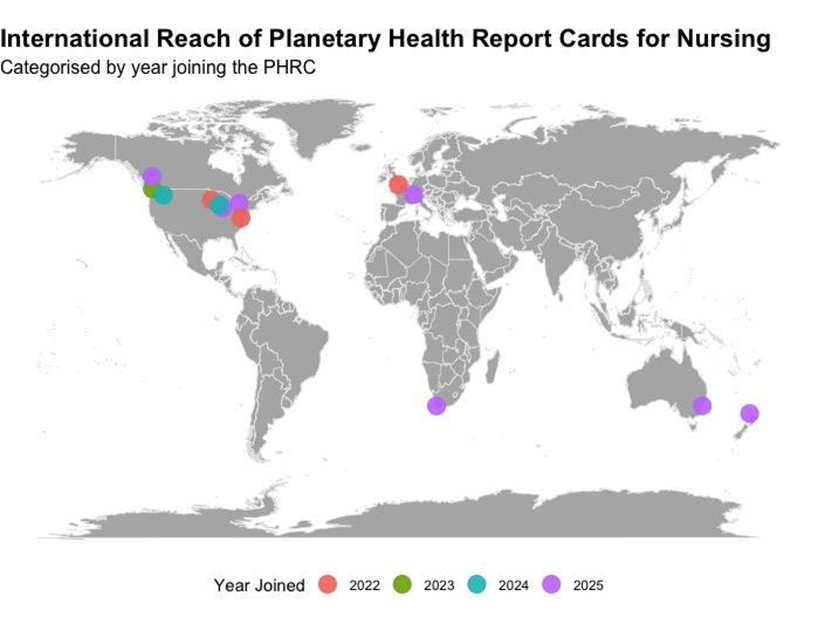
Over the last four years, the PHRC-N has been adopted internationally...Over the last four years, the PHRC-N has been adopted internationally and has reached 13 academic institutions, spanning seven countries – namely, the United States, Canada, Australia, New Zealand, Great Britain, South Africa, and Switzerland (see Figure 1). Adoption of the PHRC-N as an assessment tool for sustainability has gradually increased from three schools to 10 in the latest report cycle.
Figure 1. The Geographic Distribution of Institutions Adopting the PHRC-N, Accounting for the Year of First Submission
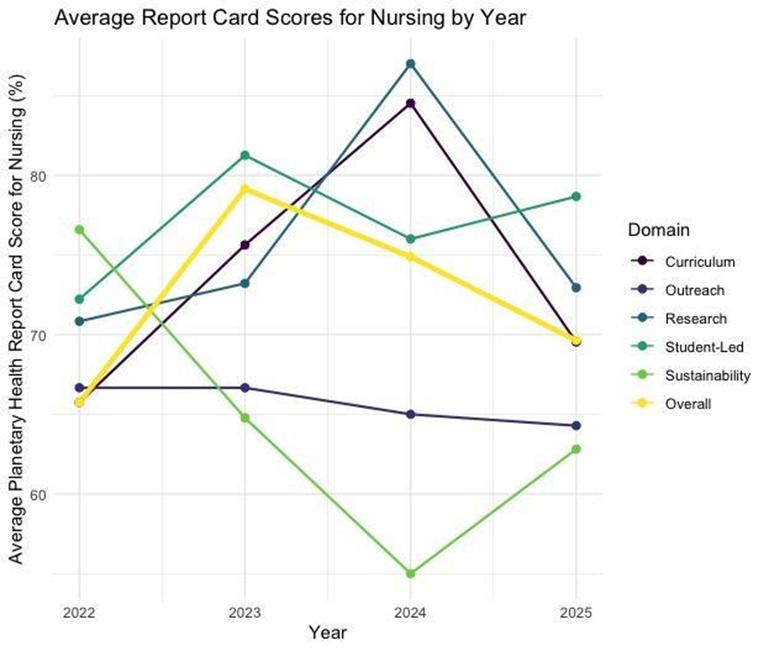
...the PHRC-N marking rubric has been altered to capture more holistically the different domains...Over the years, the PHRC-N marking rubric has been altered to capture more holistically the different domains (i.e., curriculum, community outreach, interdisciplinary research, support for student-led initiatives, and campus sustainability). As nursing schools repeat their cycles of assessment, they tend to show improvement in scores due to changes made in their respective programs. This is most indicative of improvements in planetary health teaching (see Figure 2), where the overall score for the curriculum domain increased by nearly 20 percent on average from 2022-2024; however, longer-term institutional changes relating to campus sustainability displayed decreasing scores. Apart from changes to the curriculum, PHRC-N scores decreased from 2023 to 2025, as a consequence of more institutions joining the PHRC-N.
Figure 2. Average Planetary Health Report Card for Nursing Scores Across Institutions, Aggregated by Year
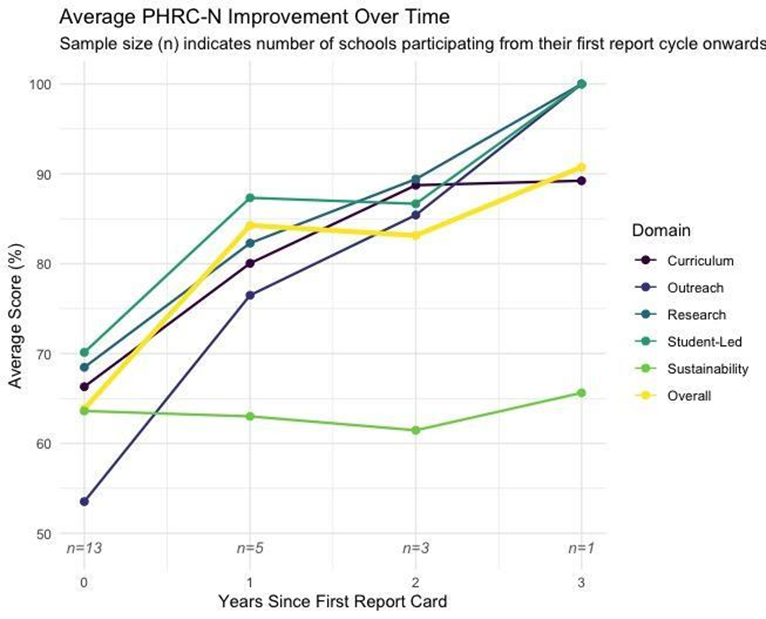
From an institutional perspective (see Figure 3), there are demonstrable increases in report card scores with successive years in almost every category. The average institution score for the curriculum domain, for example, rises from 66.3% in the first year to 80% in the second report card cycle. Likewise, for marks allocated to support for student-led initiatives, the score increased from 70.1% to 83.3% from the first to second cycle. However, it is notable that average scores for campus sustainability remain particularly stable with successive cycles, reflective of slow changes to institutional policies.
Figure 3. Average Improvement in Subsequent Years for Institutions Involved in the Planetary Health Report Card for Nursing
Cross-Institutional Practices
As four cycles have now completed, institutions undertaking the PHRC-N have been able to indicate areas for improvement. In particular, the implementation of the PHRC-N has allowed common practices to emerge across institutions, which the authors find to be points of good practice for nursing programs to consider adopting. Table 2 describes said methods of implementation across the domains, noting the proportion of schools adopting said method within the 2024/2025 report card cycle.
Table 2. Common Themes Across Institutions Participating in the PHRC-N
|
Domain |
Implementation strategy |
Percentage of schools % (n = 10) |
|---|---|---|
|
Sustainability Curriculum |
Integration of sustainability topics across multiple courses |
80% |
|
Use of both academic and experiential sources when teaching climate hazards and environmental health |
70% |
|
|
Learning activities in both traditional and interactive formats (e.g. discussions, coursework, student-led seminars, reflections) |
70% |
|
|
Interdisciplinary Research |
Inclusion and partnership of the public in planetary health research |
50% |
|
Dissemination of institutional planetary health research through symposia/conferences |
90% |
|
|
Outreach and Advocacy |
Patient-oriented resources readily accessible online or in clinical areas |
70% |
|
Empowerment of community members through partnerships and initiatives |
70% |
|
|
Support for Student-Led Initiatives |
Institutional funding/programs to facilitate students undertaking sustainability quality improvement projects |
70% |
|
Student representation in department/institution-level groups involved in sustainability policies |
60% |
Discussion
This article has described the development, implementation, and early impact of the PHRC-N, a student-led, standardized framework designed to evaluate and accelerate the integration of planetary health into nursing education. Our findings demonstrate that the PHRC-N is both scalable and impactful. Since its pilot launch in 2022, participation has expanded across institutions and countries, and repeated implementation has been associated with measurable improvements in curriculum integration and student engagement. Together, these findings suggest that the PHRC-N is a promising mechanism to catalyze institutional change in nursing education at a time when the health consequences of environmental degradation demand urgent action.
Growth, Scalability, and Institutional Uptake
The rapid expansion of the PHRC-N – from five programs in three countries during its pilot year to 13 institutions across seven countries – reflect growing global interest in integrating planetary health into nursing education. As program leaders complete an initial report, subsequent cycles become more streamlined. Teams are able to refine scoring, update progress, and track institutional change over time, reinforcing the PHRC-N as a longitudinal quality improvement framework, rather than a one-time assessment.
...the student experience has revealed important structural barriers to sustained growth.At the same time, the student experience has revealed important structural barriers to sustained growth. In several cases, highly motivated students have sought to advance the PHRC-N without sufficient administrative support. In other instances, faculty members have attempted to move the initiative forward without meaningful student engagement. These patterns indicate that scalability depends not only on the metric refinement, but on aligned leadership, shared ownership, and clear institutional pathways for collaboration.
Future growth efforts should therefore prioritize development of recruitment and leadership toolkits to help schools identify and support champions in the planetary health space. Because planetary health remains a niche focus within many nursing programs, intentional outreach beyond early adopters is essential. Expanding engagement to medical-surgical and specialty faculty will be critical to embed planetary health as a core nursing competency rather than a peripheral interest area. This scalability and sustained engagement are critical features for any initiative seeking to influence global nursing education.
Measurable Institutional Impact
The most compelling evidence of impact lies in the improvements observed among institutions that completed multiple assessment cycles. Gains were particularly pronounced in domains directly influenced by faculty and student collaboration.
Curriculum domain scores increased from an average of 66.3% in the first year to 80% in the second cycle, suggesting that formal assessment and public reporting can accelerate curricular integration of planetary health concepts. Similarly, scores related to support for student-led initiatives rose from 70.1% to 83.3%, indicating strengthened institutional recognition of student leadership as a driver of sustainability efforts.
...the PHRC-N has facilitated identification and dissemination of emerging best practices.Beyond numeric improvement, the PHRC-N has facilitated identification and dissemination of emerging best practices. The majority of participating programs now report integration of sustainability topics across multiple courses (80%) and dissemination of planetary health research through symposia or similar forums (90%). By quantifying these activities, the PHRC-N provides both accountability and a shared language for progress, enabling institutions to benchmark performance and prioritize strategic change.
Implications for Nursing Education and Practice
The integration of planetary health into nursing curricula is no longer optional; it is foundational to prepare a workforce capable of responding to climate-related health threats, environmental injustice, and resource-constrained healthcare systems. This direction is consistent with evolving accreditation standards. The 2024 Commission on Collegiate Nursing Education (CCNE) Standards for Accreditation emphasize mission alignment, curricular integrity, and achievement of program outcomes grounded in AACN Essentials (CCNE, 2024). Similarly, the Accreditation Commission for Education in Nursing (ACEN) Standard 4 requires that curricula reflect contemporary professional standards and competencies that demonstrate progression toward end-of-program student learning outcomes (ACEN, 2023). These expectations reinforce the need for structured integration of population and environmental health concepts within nursing programs.
The PHRC-N offers a structured pathway to operationalize this integration. Rather than introducing planetary health as an isolated topic, programs can use the PHRC-N framework to evaluate alignment across mission statements, curriculum mapping, teaching-learning strategies, and outcome assessment processes. This supports compliance with CCNE and ACEN standards related to program quality and continuous improvement, as well as AACN expectations for curricular currency and outcome-driven design.
In education, embedding planetary health longitudinally across courses fosters systems thinking and strengthens students’ ability to connect environmental determinants of health with clinical outcomes (AACN, 2021). Integration across domains such as Population Health, Systems-Based Practice, and Quality and Safety aligns with AACN competency expectations and supports measurable competency development. Experiential learning opportunities, including sustainability-focused quality improvement initiatives and community-based projects, further demonstrate application of competencies in real-world contexts.
In practice and advocacy, early engagement in institutional sustainability initiatives prepares nursing students to assume leadership roles consistent with accreditation expectations and relations to professional accountability and systems-based practice. Structured evaluation tools such as the PHRC-N support data-informed curricula changes, strengthen program self-study processes, and provide evidence of ongoing quality improvement. Furthermore, empowering students through formal evaluation processes strengthens their capacity to advocate for environmentally responsible healthcare systems and policies that protect population health.
As accreditation bodies continue to emphasize competency-based education, population health, and continuous quality improvement, structured assessment frameworks become essential to successful nursing programs. The PHRC-N can function as a complementary evaluation mechanism that supports institutions in translating high-level accreditation standards from CCNE and ACEN into measurable curricular strategies and sustained institutional changes.
Strengths and Limitations
A key strength of the PHRC-N is its student-led design...A key strength of the PHRC-N is its student-led design, which fosters grassroots engagement while maintaining institutional accountability. The structure empowers students to critically evaluate their own educational environments while creating space for dialogue with faculty and administrators. The standardized domains of the framework permit cross-institutional comparison, while its iterative refinement enhances contextual relevance and usability across diverse global programs.
However, not all domains demonstrate rapid improvement. Scores related to campus sustainability and infrastructure have remained relatively stable or shown modest fluctuations, reflecting the structural and financial complexity of institutional environmental reform. These domains often require capital investment, multi-year planning cycles, and executive-level approval; often extending beyond the score of student initiatives alone. Additionally, aggregate average scores may decline as new institutions join with lower baseline performance. While this may obscure overall progress at the high-level, it also underscores the role of the PHRC-N in expanding awareness and engagement among institutions at earlier stages of integration. These findings highlight the importance of sustained mentorship, administrative buy-in, and long-term strategic planning.
Conclusion
...the tool moves planetary health from aspirational rhetoric to measurable action.Escalating health impacts of climate change and environmental degradation require systemic transformation in how nurses are educated. The PHRC-N provides a feasible, scalable, and evidence-informed mechanism to accelerate that transformation. By combining standardized assessment, student leadership, and public accountability, the tool moves planetary health from aspirational rhetoric to measurable action. In the face of global environmental change, nursing education must evolve. The PHRC-N offers a practical roadmap – and an invitation – to do so.
Funding/Conflicts of Interest
The PHRC has no funding to disclose. The authors have no relevant conflicts of interest.
Acknowledgements
The authors would like to acknowledge the past and present PHRC leadership team, its Board of Directors, and the PHRC-N Pilot Team for their contributions to this work. We would also like to acknowledge the tremendous commitments and contributions of nursing students and faculty across the world who have implemented the PHRC-N and have been outstanding champions for its growth.
Authors
Ryne Wilson, DNP, RN, OCN, CNE
Email: wils2211@umn.edu
ORCID ID: I000-0001-7504-3337
Ryne Wilson is a Clinical Assistant Professor at the University of Minnesota School of Nursing, Board Member of the Planetary Health Report Card, and co-creator of the Planetary Health Report Card for Nursing. He is an Oncology Certified Nurse and a certified Academic Nurse Educator holding a Bachelors of Science in Nursing from Western Kentucky University and a Doctor of Nursing Practice in Health Innovation and Leadership from the University of Minnesota.
Chezko Malachi Peligrino Castro, MSc
Email: c.castro@lancaster.ac.uk
ORCID ID: 0000-0003-0120-2141
Malachi Castro serves as the Planetary Health Report Card Data & Analytics Co-Lead. He is a final-year medical student at Lancaster Medical School and holds a Masters of Health Data Science from Lancaster University.
Ashley Smith, DNP, RN, PHN, CNE
Email: ashsmith@westcoastuniversity.edu
ORCID ID: 0009-0000-6785-4260
Ashley Smith is a public health nursing faculty member at West Coast University-Los Angeles and the Nursing Lead for the Planetary Health Report Card. She is certified as a Public Health Nurse and academic nurse educator and holds a Bachelor of Science in Nursing from West Coast University, a Master of Science in Nursing from Sacramento State University, and a Doctor of Nursing Practice in Population Health from the University of Wisconsin- Madison.
References
Accreditation Commission for Education in Nursing (ACEN). (2023). 2023 Accreditation Manual for Nursing Education Programs. https://www.acenursing.org/accreditation/accred-manual/accreditation-manual
American Association of Colleges of Nursing (AACN). (2021). The essentials: Core competencies for professional nursing education. https://www.aacnnursing.org/Portals/0/PDFs/Publications/Essentials-2021.pdf
American Association of College of Nursing- Commission on Collegiate Nursing Education (CCNE). (2025). Procedures for Accreditation of Baccalaureate and Graduate Nursing Programs. Amended January 14, 2025. https://www.aacnnursing.org/portals/0/PDFs/CCNE/Procedures.pdf
American Nurses Association (ANA). (2023). Nurses’ role in addressing global climate change, climate justice, and health [position statement]. https://www.nursingworld.org/globalassets/practiceandpolicy/nursing-excellence/ana-position-statements/social-causes-and-health-care/nursesroleinaddressingglobalclimatechangeclimatejusticeandhealth_bod-approved.pdf
Aronsson, J., Nichols, A., Warwick, P., & Elf, M. (2024). Nursing students’ and educators’ perceptions on sustainability and climate change: An integrative review. Journal of Advanced Nursing, 80(8), 3072-3085. https://doi.org/10.1111/jan.15950
Breakey, S., Starodub, R., Nicholas, P. K., & Wong, J. (2023). A cross-sectional study to assess faculty and student knowledge of climate change and health: Readiness for curricular integration. Journal of Advanced Nursing, 79(12), 4716-4731. https://doi.org/10.1111/jan.15729
Cygan, H., Garman, A. N., Basapur, S., & Bejster, M. (2024). Turning concern into confidence: Planetary health needs in nursing education. Journal of Nursing Education, 63(3), 178-181. https://doi.org/10.3928/01484834-20240108-09
Ebi, K. L. & Hess, J. J. (2024). Introduction to JAMA climate change and health series. JAMA, 331(5), 436-437. https://doi.org/10.1001/jama.2023.25878
Faerron Guzmán, C. & Potter, T. (2021). The planetary health education framework. Planetary Health Alliance. https://doi.org/10.5822/phef2021
Hampshire, K., Islam, N., Kissel, B., Chase, H., & Gundling, K. (2022). The Planetary Health Report Card: A student-led initiative to inspire planetary health in medical schools. The Lancet Planetary Health, 6(5), E449-E454. https://doi.org/10.1016/S2542-5196(22)00045-6
Kurth, A. E. (2017). Planetary health and the role of nursing: A call to action. Journal of Nursing Scholarship, 49(6), 598-605. https://doi.org/10.1111/jnu.12343
LeClair, J. & Potter, T. (2022). Planetary health nursing. American Journal of Nursing, 122(4), 47-52. https://doi.org/10.1097/01.NAJ.0000827336.29891.9b
National Academies of Science, Engineering, and Medicine (NASEM). (2021). The future of nursing 2020-2030: Charting a path to achieve health equity. The National Academies Press. https://doi.org/10.17226/25982
Planetary Health Alliance. (2025). What is planetary health? https://planetaryhealthalliance.org/what-is-planetary-health/
Planetary Health Report Card (PHRC). (2025). About us. https://phreportcard.org/about/
Planetary Health Report Card (PHRC). (2025a). Nursing. https://phreportcard.org/nursing/
Planetary Health Report Card (PHRC). (2025b). Metrics. https://phreportcard.org/metrics/
Potter, T. (2021). Planetary health: An essential framework for nursing education and practice. Creative Nursing, 27(4), 226-230. https://doi.org/10.1891/cn-2021-0017
Quinn Griffin, M. T., Alfes, C. M., Chavez, F., Ea, E. E., Lynn, K. A., Rafferty, M. A., & Fitzpatrick, J. J. (2022). Incorporating climate change into doctor of nursing practice curricula. Journal of Professional Nursing, 42, 156-161. https://doi.org/10.1016/j.profnurs.2022.06.008
Romanello, M., McGushin, A., Di Napoli, C., Drummond, P., Hughes, N., Jamart, L., Kennard, H., Lampard, P., Rodriguez, B. S., Arnell, N., Ayeb-Karlsson, S., Belesova, K., Cai, W., Campbell-Lendrum, D., Capstick, S., Chambers, J., Chu, L., Ciampi, L., Dalin, C., … Hamilton, I. (2021). The 2021 report of the Lancet Countdown on health and climate change: Code red for a healthy future. The Lancet, 398(10311), P1619-1662. https://doi.org/10.1016/S0140-6736(21)01787-6
Vandenberg, S., Strus, J. A., Chircop, A., Egert, A., & Savard, J. (2025). Planetary health in nursing: A scoping review. Journal of Advanced Nursing, 81(12), 8080-8115. https://doi.org/10.1111/jan.16570
Walton, A. L., Stanifer, S. R., Wilson, R., & Allen, D. H. (2025). The impact of climate change across the cancer control continuum: Key considerations for oncology nurses. Oncology Nursing Forum, 52(1), 6-14. https://doi.org/10.1188/25.onf.6-14
White, J., Gunn, M., Chiarella, M., Catton, H., Steward, D. (2025). Renewing the definition of ‘nursing’ and ‘a nurse’. International Council of Nurses. https://www.icn.ch/sites/default/files/2025-06/ICN_Definition-Nursing_Report_EN.pdf
Wilson, R., Burbage, D., Dickman, E., & Ginex, P. (2024). Navigating through disaster: Application of oncology nurse navigator competencies to climate disaster preparation and response. Seminars in Oncology Nursing, 40(2), 151581. https://doi.org/10.1016/j.soncn.2024.151581
World Health Organization (WHO). (2023). Climate change. https://www.who.int/news-room/fact-sheets/detail/climate-change-and-health
World Health Organization (WHO). (2025). Nursing and midwifery. https://www.who.int/news-room/fact-sheets/detail/nursing-and-midwifery


