




Complex systems that permit life to survive and thrive on this planet are severely threatened. The human-caused breakdown of these systems disrupts health and well-being and reverses hard-won gains in global health. These harms can be reversed by addressing underlying drivers, including values, behaviors, pattens of consumption, and harmful technologies, and adopting a paradigm where we recognize our interconnection within Nature. International and national professional nursing organizations call nurses around the globe to realize that caring for the planet is part of the roles and responsibilities of being a nurse. Once nurses learn about the Planetary Health paradigm and its shared language, vision, and global strategies, they will be prepared to care for those suffering from the health impacts of climate change and other environmental disruptions. They will be equipped to teach communities about strategies for adaptation. Nurses educated about planetary health can research the best ways to address social and environmental determinants of health that create unequal impacts. They will be prepared to advocate and lead movements to change underlying drivers that cause planetary health disruptions. The purpose of this article is to define planetary health, briefly discuss its origin and history, introduce core planetary health concepts, and invite nurses to join the movement.
Key Words: Planetary health, planetary boundaries, transdisciplinary, climate change, interconnection within nature, movement building, nursing paradigm
Florence Nightingale wrote, “nature alone heals” and the role of the nurse is to “put the patient in the best condition for nature to act upon him” (Nightingale, 1860/1969, p. 133). However, what do we do when Nature is the patient? When nature is threatened, humans cannot heal. Our fates are absolutely interconnected.
...nurses can play a significant role in restoring the health of the planet.The Earth is showing signs of multi-system failure (Potsdam Institute, 2025). The root cause of this collapse are human behaviors and values that severely threaten the health and well-being of the systems upon which all life depend (Planetary Health Alliance [PHA] n.d.a). Considering the Code of Ethics for Nurses (American Nurses Association [ANA], 2025), nurses’ position as trusted voices (Brenan, 2026), and nursing expertise in behavior change, nurses can play a significant role in restoring the health of the planet. To do so, nurses need to view planetary health as an essential part of the nursing paradigm and profession.
To move ahead at the scale and urgency that this crisis requires, nurses will need to understand the history of planetary health, core planetary health concepts, and how they can join the social movement. The intent of this article is to provide nurses with a basic introduction to Planetary Health and an invitation to nurse for planetary health.
Background
Until the last century or two, human survival depended on a deep interconnection with the rest of Nature. Understanding weather patterns, the migratory habits of wildlife, the medicinal purposes of plants, and the location of quality foods were essential knowledge. So too were values of reciprocity, kinship with all beings in Nature, and the importance of protecting the environment for future generations (Faerron Guzmán & Potter, 2021).
For a variety of reasons many humans forgot their interconnection within Nature and began to see the rest of Nature as a resource to exploit. The price for that way of thinking and acting is coming due. In fact, the report of the Rockefeller Foundation-Lancet Commission on Planetary Health stated, “We have been mortgaging the health of future generations to realize economic and development gains in the present” (Whitmee et al., 2015, p. 1973).
Climate patterns, levels of biodiversity, and air, soil, and water quantities and qualities are changing. The United Nations Framework Convention on Climate Change ([UNFCCC], 2022) call these threats, the “triple planetary crisis.” These changes are so extreme that they threaten human health, lives, and quality of life around the globe.
The environmental crisis is not limited to climate change, or even the triple threat...The environmental crisis is not limited to climate change, or even the triple threat of climate change, biodiversity loss, and pollution. Scientists at the Stockholm Resilience Centre at Stockholm University have identified nine planetary processes that cannot be exceeded if we are to maintain a stable and resilient Earth that can support human life. These planetary boundaries include changes in freshwater, land use, climate change, biosphere integrity, stratospheric ozone depletion, atmospheric aerosol loading, ocean acidification, biogeochemical flows of nitrogen and phosphorus, and novel entities such as the introduction of synthetic chemicals (Stockholm Resilience Centre, n.d.). As of 2025, seven of the nine essential planetary boundaries had been crossed (Sakschewski et al., 2025) (See Figure 1).
Figure 1. The Evolution of the Planetary Boundaries Framework
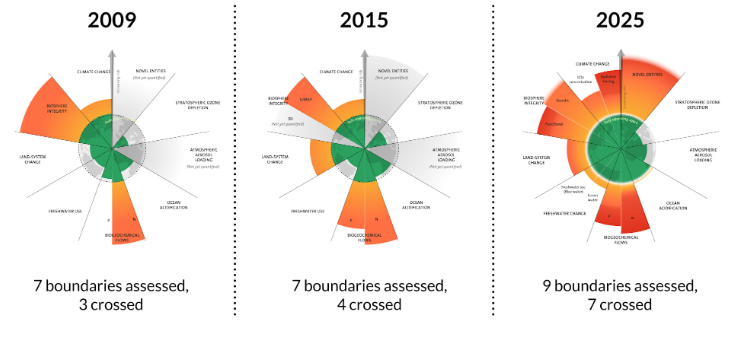
Licensed under CC BY-NC-ND 3.0 Azote for Stockholm Resilience Centre, Stockholm University. Based on Sakschewski et al. 2025, Richardson et al. 2023, Steffen et al. 2015, and Rockström et al. 2009).
Rapid and accurate assessments and skilled interventions are essential for preserving life.Many nurses recognize that when the vast majority of a patient’s systems are failing, life is no longer possible, or not possible at its former quality. Rapid and accurate assessments and skilled interventions are essential for preserving life. Planetary Health provides the necessary knowledge, skills, and systems change strategy to restore the health of the planet.
Planetary Health
Roots of Planetary Health
...Planetary Health starts with and remains deeply reliant on Indigenous ways of knowing.Understanding interconnection and valuing all the systems and environmental elements that impact the health of humans is an ancient way of Indigenous knowing. As Hindou Oumarou Ibrahim, Indigenous leader and Chair of Planetary Guardians states, “To heal our planet, we must unite science and traditional knowledge, respecting the wisdom of those who live closest to the land and waters” (Potsdam Institute, 2025, para. 13). Despite making up only 5% of the global population, Indigenous people provide stewardship for 80% of all remaining biodiversity (World Economic Forum, 2023). Therefore, it is important to understand that Planetary Health starts with and remains deeply reliant on Indigenous ways of knowing.
Planetary Health Defined
More recently, mounting data convinced the fields of science and health to cooperate to recognize and find solutions to the profound threats to human health being caused by environmental disruptions. In 2015, the seminal paper, “Safeguarding human health in the Anthropocene epoch: report of The Rockefeller Foundation–Lancet Commission on planetary health” (Whitmee et al., 2015) launched the modern Planetary Health movement. The commission defined Planetary Health as “the health of human civilization and the state of the natural systems on which it depends” (p. 1978).
This revised definition ensured the inclusion of all species, not just humans.As the Planetary Health movement grew, the definition of Planetary Health was modified to, “Planetary Health is a solutions-oriented, transdisciplinary field and social movement focused on analyzing and addressing the impacts of human disruptions to Earth’s natural systems on human health and all life on Earth” (Planetary Health Alliance [PHA], n.d.b., para. 1). This revised definition ensured the inclusion of all species, not just humans.
Several models of human, animal, and ecosystem health exist. Public health, eco health, global health, and One Health all address the intersection of humans, animals, and the environment. Where public health and global health include animal health and the environment, the emphasis is still on humans. Eco-health emphasizes the environment, and One Health focuses on the diagnosis and treatment at the intersection of humans and animals. Even though there is a great deal of overlap in the different models (Ruiz de Castañeda, 2023), Planetary Health is the most inclusive and comprehensive; it includes the other models as well as additional fields and ways of knowing.
Transdisciplinarity
Planetary Health is by definition a transdisciplinary field and movement.Planetary Health is by definition a transdisciplinary field and movement. That means it moves beyond multidisciplinary and interprofessional relationships to include a different approach to knowing and knowledge construction. Transdisciplinarity creates an opportunity for disciplines to discern what they have in common and imagine what might be possible when different knowledge systems come together (Charter of Transdisciplinarity, International Center for Transdisciplinary Research [CIRET], 2020).
It is very important for members of every discipline to recognize that they cannot restore Planetary Health alone. The complexity of restoring Earth’s natural systems will require a new way of knowing and learning - one based on broad cross-sector relationships and deep humility. We will only be able to solve the crisis by bringing people from all demographics and expertise together to create effective solutions. This is an essential understanding in the new paradigm.
Planetary Health Schematic
Health can no longer be solely thought of in terms of individual health or even global health.Modern values, behaviors, and patterns of consumption are underlying drivers of this massive disruption of the planet’s life support system. Population size, demographic changes, and technologies exacerbate the problems (Myers et al., 2025). Health can no longer be solely thought of in terms of individual health or even global health. We need to think at the planetary health level. Human behaviors are causing significant changes to the Earth’s nine planetary boundaries. These changes result in proximate causes that can directly impact health. The schematic also illustrates that structural and social determinants can modify or amplify the severity of the health impacts. (See Figure 2)
Figure 2. Planetary Health: Protecting Human Health on a Rapidly Changing Planet
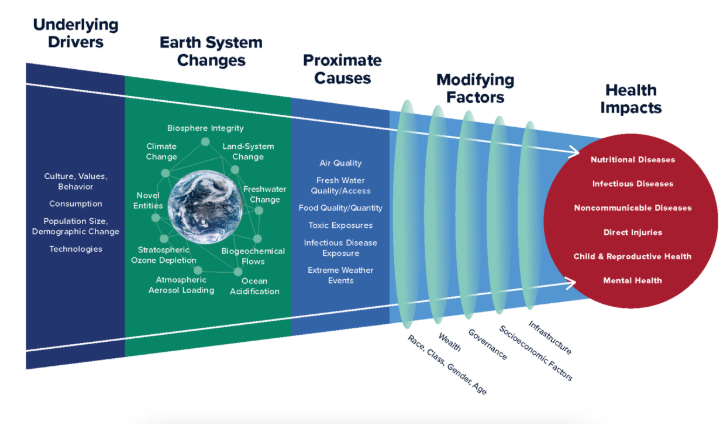
Graphic modified in 2025 from: Myers, S.S., 2017. Planetary health: protecting human health on a rapidly changing planet. The Lancet, 390(10114), pp.2860-2868.
Duff H., Faerron Guzmán, C., Almada, A., Golden, C., and Myers, S. “Planetary Health Case Studies: An Anthology of Solutions”. PHA, Boston, USA. 2020; https://doi.org/10.5822/phanth9678
Considering Figure 2, nurses are well prepared to analyze and address the health impacts of environmental degradation. Public health education prepares nurses to address the modifying factors. What is new for many nurses, however, is the understanding that the underlying drivers, or human behaviors, that are disrupting the Earth’s natural systems are also the root causes of many communicable and non-communicable diseases. This level of “upstream” thinking may offer nurses a leverage point for advocacy and action to create significant change.
Planetary Health as a Social Movement
Planetary health is not only a field, but also a social movement promoting meaningful action in business, governance, and education (PHA, 2024). Its holistic and comprehensive principles position nurses to ideate and lead value-based solutions to address the underlying drivers of this urgent and complex planetary crisis.
Organizing and mobilizing a highly effective global Planetary Health movement requires a shared language, a shared vision, and a shared strategy. The following section discusses three essential organizing resources for the Planetary Health movement: the Planetary Heath Education Framework (PHEF), the Sao Paulo Declaration on Planetary Health, and the Planetary Health Roadmap and Action Plan.
Planetary Heath Education Framework
The Planetary Health Education Framework (Faerron Guzmán & Potter, 2021) offers the shared language, or core principles, that support transdisciplinary relationships for Planetary Health education. The framework is not a list of competencies; it instead describes five core domains that can guide development of the Planetary Health paradigm across disciplines. The five core domains are discussed below.
Interconnection Within Nature. This domain is based on Indigenous knowledge systems that recognize humans are part of Nature and all of Nature is deeply interconnected (Faerron Guzmán et al., 2021). Upon recommendation of Indigenous leaders, the editors of the Planetary Health Education Framework (Faerron Guzmán & Potter, 2021) capitalized the word Nature to shift the paradigm from us thinking of Nature as an object to thinking of Nature as a subject or relation worthy of kinship. The false narrative that humans are separate from Nature and somehow exceptional, and more important than the rest of Nature, has been a significant underlying driver of our extractive and polluting industries and loss of biodiversity. The authors of the framework feel so strongly about this necessary shift in thinking, that the Interconnection Within Nature domain is at the center of the five domains. (See Figure 3)
This domain is based on Indigenous knowledge systems that recognize humans are part of Nature and all of Nature is deeply interconnected.The PHEF image is designed to represent the cross section of a rope. “While the domains can be teased out one by one…, they only function appropriately when interwoven together. The analogy also emphasizes that the total strength of the framework, similar to a rope and its threads, is larger than the sum of its parts” (Faerron Guzmán & Potter, 2021, p. 12).
Figure 3. Planetary Health Education Framework
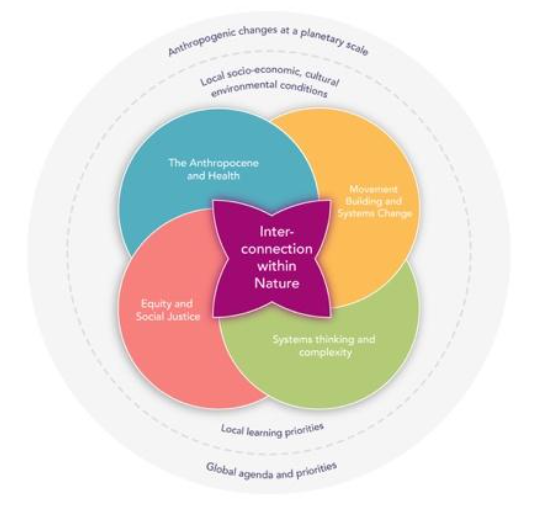
Permission to use obtained from the editors of the Planetary Health Education Framework and the Planetary Health Alliance
The Anthropocene and Health. It is essential for students in all fields to realize that human behaviors are causing the planetary boundaries to be exceeded. Too often a false narrative suggests that extreme weather events are part of Earth’s natural cycles and not a result of burning fossil fuels. There is also a common belief that technology will be able to solve all our problems. To shift the paradigm, solutions must be based on science and address values and behaviors rather than simply layering on new forms of technology that may have unintended consequences.
We are one interconnected system.Equity and Social Justice. We are one interconnected system. As Dr. Martin Luther King Jr. said, “Injustice anywhere is a threat to justice everywhere. We are caught in an inescapable network of mutuality, tied in a single garment of destiny. Whatever affects one directly affects all indirectly” (King, 1963, para. 4). The PHEF acknowledges that frontline communities, those living in areas most impacted by extreme weather events and ecosystem destruction; and fenceline communities, those living in the shadow of polluting industries, often suffer disproportionately. Therefore, it is important for students and Planetary Health practitioners to learn principles of equity and social justice, also known as environmental justice.
Systems Thinking and Complexity. Today many people seek easy and quick solutions to complex global challenges; in doing so, they might inadvertently add to the problem. Students in every discipline need to understand that our future depends on shared ideas and knowledge. Students and Planetary Health practitioners need to learn how to communicate and collaborate broadly with diverse disciplines, sectors, and demographics to create new solutions and avoid unintended consequences.
Movement Building and Systems Change. It is not enough to talk; we need to act. There is an art and science of movement building. Planetary health practitioners need to find each other, network, and collaborate for maximum effectiveness. Systems change does not happen with one action; it requires many actions over time. Therefore, strategic thinking and how to organize are key aspects of planetary health education.
The Planetary Health Education Framework (Faerron Guzmán & Potter, 2021), with its five domains, thus provides the values and a shared language to help us work in transdisciplinary solutions. However, we need a shared vision to focus our energies and coordinate our actions.
Sao Paulo Declaration on Planetary Health
The declaration then provides a “blueprint” for every sector including urban planning, agriculture, research, education, and healthcare.The shared vision for the Planetary Health movement can be found in the Sao Paulo Declaration on Planetary Health (PHA, 2021). The declaration was co-created by members of the global planetary health community of practitioners to promote systems thinking and transdisciplinary awareness to create an alternative vision of the future. It begins, “We need a fundamental shift in how we live on Earth, what we are calling the Great Transition. Achieving the Great Transition will require rapid and deep structural changes across most dimensions of human activity” (PHA, 2021, p. 3). The declaration then provides a “blueprint” for every sector including urban planning, agriculture, research, education, and healthcare. For nurses and other health professionals, the declaration calls for a paradigm shift where the chief responsibilities of healthcare are “disease prevention, health promotion, and health equity” (p. 6).
The Planetary Health Roadmap and Action Plan
Once movements have a shared language and vision, the next step is to develop a shared strategy. The Planetary Health Roadmap and Action Plan (PHA, 2024) focuses on key leverage points shared across the globe; these include governance, business, education, and communication. The Earth is one interconnected ecosystem; therefore, it is important for solutions and strategies to work across borders. The roadmap provides this global strategy.
...it is important for solutions and strategies to work across borders.The Planetary Health Education Framework, the Sau Paulo Declaration on Planetary Health, and the Planetary Health Roadmap and Action Plan support the transdisciplinary Planetary Health movement and field. However, it is equally important to mobilize within disciplines. Each field has unique knowledge and spheres of influence. Nursing for Planetary Health describes the unique contribution of nurses to the movement.
Nursing for Planetary Health
Given 29 million nurses and 2.2 million midwives globally (World Health Organization, 2025), the nursing profession can have significant impact in the design and promotion of planetary health solutions. Furthermore, in addition to providing skilled care to treat people suffering from the health impacts of environmental harms, nurses can promote adaptation and resilience. The recognized status of nurses as “trusted voices” (Brenan, 2026) also means they can effectively address the underlying drivers of our planetary crisis. Individual nurses can enhance the impact of their advocacy when they collaborate with national and international nursing organizations. Working together, nurses can encourage the changes that are necessary to move humanity toward a healthier future. This section discusses relevant professional nursing organizations in the United States and globally.
Professional Nursing Organizations in the United States
American Nurses Association. Professional nursing organizations in the United States are making tremendous strides in advancing nursing for Planetary Health and well-being. For example, the ANA (2023a) developed a position statement, Nurses’ Role in Addressing Global Climate Change, Climate Justice, and Health. This document calls for nurses to recognize that “Planetary health and the effects of climate change are pressing issues that directly impact the health of our patients, communities, nursing practice, nursing ethics, and work environments” (p. 9). To support nurse-driven planetary health solutions, the ANA added an Innovation Advisory Committee (IAC) specifically focused on global and planetary health (ANA, 2023b).
The ANA has also embedded Planetary Health in some of its core initiatives.The ANA has also embedded Planetary Health in some of its core initiatives. For example, the 2025 edition of the ANA Code of Ethics for Nurses includes a statement about Planetary Health. Principle 10.5 states:
Human life and health are profoundly affected by the state of the natural world that surrounds us. Planetary health challenges include environmental degradation, aridification, exploitation of Earth’s resources, ecosystem destruction, climate change, waste, microplastics, forever chemicals, and other environmental assaults. These disproportionately affect the health of the poor and ultimately affect the health of all humanity. Nursing advocates for policies, programs, legislation, and practices that maintain and sustain the natural world. (ANA, 2025, p.46)
The National League for Nursing (NLN). The NLN (2022) published the NLN Vision Statement: Climate Change in Health, which states, “All schools of nursing must integrate climate change and planetary health content into their curricula at all levels of education” (p. 7). The NLN also created a Center of Excellence (COE) for Creating Learning Environments that Impact Climate Change & Planetary Health. This COE allows recognition for nursing schools that demonstrate commitment to educating climate- and planetary health nurses ready to practice in a changing world.
Global Organizations Supporting Nursing for Planetary Health
International Council of Nurses (ICN). The ICN has a long history of addressing environmental concerns and climate change. An example is the 2008 position statement, “Nurses, Climate Change, and Health” (ICN, 2024). The International Council of Nurses Code of Ethics (ICN, 2021) states, “Nurses collaborate and practice to preserve, sustain and protect the natural environment and are aware of the health consequences of environmental degradation, e.g. climate change. They advocate for initiatives that reduce environmentally harmful practices to promote health and well-being” (p. 18). The ICN is very clear - protecting the environment is a core ethic for all nurses.
The ICN is very clear - protecting the environment is a core ethic for all nurses.Most recently, the ICN published two documents that specifically advocate for Planetary Health. “Nursing for Planetary Health and Well-Being” (Potter et al., 2025) encourages nurses around the globe to advance Planetary Health through research, education, advocacy, leadership, and practice. The 2024/2025 ICN Nursing Student Steering Group and the ICN Alliance of Student and Early Career Nurses published a supporting statement. Their statement concludes with, “Because there is no health without a healthy planet and there is no future of health without the education of nurses who are prepared to protect it. Nurse the planet. Heal the future” (Juhl et al., 2025, para. 6). Future and early career nurses understand that it is essential to receive adequate preparation to practice in a world where planetary boundaries have been exceeded.
The Planetary Health Report Card for Nursing. If schools of nursing fail to teach students about planetary health, students can act by joining the Planetary Health Report Card (PHRC) for Nursing. This annual student-driven report describes their school’s strengths related to planetary health education and where opportunities for growth exist (PHRC, n.d.). As of 2025, 13 schools of nursing in seven different nations have participated in the PHRC for Nursing.
Nightingale Initiative for Global Health (NIGH). The mission of NIGH includes supporting the United Nations in strategic global health goals. NIGH recognizes that there cannot be global health without planetary health; therefore, NIGH hosted “Planetary Health: A Virtual Global Conference for Nurses and Midwives” in April 2026 (NIGH, n.d.). This 48-hour virtual conference offered nurses and midwives from six global regions, an introduction to Planetary Health and how to get involved in their own region.
Alliance of Nurses for Healthy Environments (ANHE). ANHE is a global nursing professional organization focused on the intersection of human health and planetary health. The ANHE mission is to “support nurses in promoting planetary health and equity globally by educating and leading the nursing profession, advancing research, incorporating planet-safe practice, and influencing policy” (ANHE, n.d., para. 2). ANHE offers workshops and seminars on a wide variety of environmental issues including microplastics, forever chemicals such as per- and polyfluoroalkyl substances (PFAS), climate change, and healthcare-generated waste. The organization offers a fellowship program, tools for environmental advocacy, and a vast network of members across the globe.
Each of these national and international nursing commitments affirm nursing’s reputation as a key partner in advancing and restoring Planetary Health. With this support, there are many, many actions that nurses can take to support restoration of Planetary Health.
Invitation to Join the Movement
If we work across disciplinary boundaries, new solutions become possible.The first step that nurses can take as supporters of Planetary Health is to make sure that they are not alone. If we work across disciplinary boundaries, new solutions become possible. Working together also helps alleviate the ecoanxiety and despair that some experience when they think about the many ways we are harming the Earth. Nurses are highly encouraged to join the Planetary Health Alliance (PHA). Membership is free and offers newsletters and updates on research. Through the PHA, nurses can join their regional hub and be connected to others working to create change locally, as well as globally (PHA, n.d.c.).
It is an ethical obligation and professional responsibility of nurses to protect the environment to ensure health. More than ever nurses’ knowledge and skilled expertise are needed to create lasting changes that will ensure a healthy planet for future generations.
Author
Teddie M. Potter, PhD, RN, FAAN
Email: tmpotter@umn.edu
Dr. Potter is deeply committed to planetary health education and movement building. She was the inaugural director of the Center for Planetary Health and Environmental Justice at the School of Nursing at the University of Minnesota. She is a board member of the Alliance of Nurses for Healthy Environments, a member of the American Academy of Nursing Environment and Public Health Expert Panel, and she is a member of the Steering Committee of the Planetary Health Alliance (PHA). She serves on the National Academy of Medicine’s Action Collaborative on Decarbonizing the U.S. Health Sector, and the Climate Crossroads committee of the National Academies of Science, Engineering, and Medicine (NASEM). Her most recent work is partnering with the International Council of Nurses to promote Nursing for Planetary Health.
References
Alliance of Nurses for Healthy Environments. (n.d.). Mission. https://envirn.org/
American Association of Colleges of Nursing. (2021) The essentials: Core competencies for professional nursing education. https://www.aacnnursing.org/Portals/0/PDFs/Publications/Essentials-2021.pdf
American Nurses Association. (2025). Code of ethics for nurses. American Nurses Association.
American Nurses Association. (2023a). Nurses’ role in addressing global climate change, climate justice, and health. American Nurses Association. https://www.nursingworld.org/globalassets/practiceandpolicy/nursing-excellence/ana-position-statements/social-causes-and-health-care/nursesroleinaddressingglobalclimatechangeclimatejusticeandhealth_bod-approved.pdf
American Nurses Association. (2023b). Innovation advisory committee- global and planetary health. https://www.nursingworld.org/globalassets/innovation/guide/iac-planetary-and-global-health-resources_2024-updates_final.pdf
Brenan, M. (2026, January 12). Nurses continue to lead in honesty and ethics ratings. Gallup. https://news.gallup.com/poll/700736/nurses-continue-lead-honesty-ethics-ratings.aspx.
Duff H., Faerron Guzmán, C., Almada, A., Golden, C., & Myers, S. (2020). Planetary Health Case Studies: An Anthology of Solutions. Planetary Health Alliance. https://doi.org/10.5822/phanth9678
Faerron Guzmán, C. A., & Potter, T. (2021). Planetary health education framework. Planetary Health Alliance. https://planetaryhealthalliance.org/resources/education-framework/
Faerron Guzmán, C. A., Aguirre, A. A., Astle, B., Barros, E., Bayles, B., Chimbari, M., El-Abbadi, N., Evert, J., Hackett, F., Howard, C., Jennings, J., Krzyzek, A., LeClair, J., Maric, F., Martin, O., Osano, O., Patz, J., Potter, T., Redvers, N., rienekens, N., Walpole, S., & Zylstra, M. (2021). A framework to guide planetary health education. Lancet Planetary Health, 5(5), E253-E255. https://doi.org/10.1016/S2542-5196(21)00110-8
International Center for Transdisciplinary Research (CIRET). (2020). Charter of Transdisciplinarity. https://ciret-transdisciplinarity.org/chart.php#en
International Council of Nurses. (2024). International Council of Nurses position statement: Nurses, climate change and health [Internet]. Geneva: International Council of Nurses. https://www.icn.ch/sites/default/files/2024-11/Nurses%20climate%20change%20health%20PS_EN.pdf
International Council of Nurses. (2021). Code of ethics for nurses. International Council of Nurses. https://www.icn.ch/sites/default/files/2023-06/ICN_Code-of-Ethics_EN_Web.pdf
Juhl, M., Nugraha, D. D., Park, S., Irenko, C., Molina, T., Setholi, M. D., Bukhamseen, A. (2025). Planetary health and climate change. International Council of Nurses. https://www.icn.ch/sites/default/files/2025-05/Planetary%20Health%20SECN%20statement%20-%20EN_0.pdf
King, M. L. (1963). Letter from Birmingham jail. https://www.africa.upenn.edu/Articles_Gen/Letter_Birmingham.html
Myers, S. S., Masztalerz, O., Ahdoot, S., Gabrysch, S., Gupta, J., & Haines, A. (2025). Connecting planetary boundaries and planetary health: A resilient and stable Earth system is crucial for human health. The Lancet 0(0). https://doi.org/10.1016/S0140-6736(25)01256-5
Myers, S.S. (2017). Planetary health: Protecting human health on a rapidly changing planet. The Lancet, 390(10114), pp.2860-2868. https://doi.org/10.1016/S0140-6736(17)32846-5
National League for Nurses. (2024). Creating learning environments that impact climate change and planetary health. https://www.nln.org/docs/default-source/default-document-library/vision-series-climate-change-health.pdf?sfvrsn=86ee3340_3
National League for Nurses. (2022). NLN vision statement: Climate change and health. https://www.nln.org/docs/default-source/default-document-library/vision-series-climate-change-health.pdf?sfvrsn=86ee3340_3
Nightingale, F. (1969). Notes on nursing: What it is and what it is not. New York: Dover. (Original work published 1860).
Nightingale Initiative for Global Health [NIGH]. (n.d.). Nightingale Initiative for Global Health. https://www.nighvision.net/
Planetary Health Alliance. (n.d.a.). Understanding planetary health pathways: Underlying drivers. https://planetaryhealthalliance.org/planetary-health-schematic/
Planetary Health Alliance. (n.d.b.). What is planetary health? https://planetaryhealthalliance.org/what-is-planetary-health/
Planetary Health Alliance. (n.d.c.). Ready to get involved? https://planetaryhealthalliance.org/get-involved/
Planetary Health Alliance. (2024). Planetary health roadmap and action plan. https://planetaryhealthalliance.org/roadmap-action-plan/
Planetary Health Alliance. (2021). Sao Paulo declaration on planetary health. https://planetaryhealthalliance.org/pledges-declarations/sao-paulo-declaration/
Planetary Health Report Card. (n.d.). Planetary health report card: Nursing. https://phreportcard.org/nursing/
Potsdam Institute for Climate Impact Research. (2025, September 24). Seven of nine planetary boundaries now breached – ocean acidification joins the danger zone. https://www.pik-potsdam.de/en/news/latest-news/seven-of-nine-planetary-boundaries-now-breached-2013-ocean-acidification-joins-the-danger-zone
Potter, T., Burton, E., Astle, B., & Honegger-Rogers, H. (2025). Nursing for planetary health and well-being. International Council of Nurses. https://www.icn.ch/sites/default/files/2025-05/Planetary%20Health%20Topic%20Brief%20-%20EN_0.pdf
Richardson, K., Steffen W., Lucht, W., Bendtsen, J., Cornell, S.E., Donges, J.F., Drüke, M., Fetzer, I., Bala, G., von Bloh, W., Feuler, G., Fiedler, S., Gerten, D., Gleeson, T., Hofmann, M., Huiskamp, W., Kummu, M., Mohan, C., Nogués-Bravo, D., …Rockström, J. (2023). Earth beyond six of nine Planetary Boundaries. Science Advances, 9(37), 1-16. https://doi.org/10.1126/sciadv.adh2458
Rockström, J., Steffen, W., Noone, K., Persson, Å., Chapin, F. S., Lambin, E. F., Lenton, T. M., Scheffer, M., Folke, C., Schellnhuber, H. J., Nykvisst, B., de Witt, C. A., Hughes, T., van der Leeuw, S., Rodhe, H., Sorlin, S., Snyder, P.K., Contnaza, R., Svedin, U., …Foley, J. A. (2009). A safe operating space for humanity. Nature, 461, 472-475. https://doi.org/10.1038/461472a
Ruiz de Castañeda, R., Villers, J., Faerron Guzmán, C.A., Eslanloo, T., de Paula, N., Machalaba, C., Zinsstag, J., Utzinger, J., Flahault, A., & Bolon, I. (2023). One Health and planetary health research: Leveraging differences to grow together. Lancet Planetary Health, 7(2), e109-e111. https://doi.org/10.1016/S2542-5196(23)00002-5
Sakschewski, B., Caesar, L., Andersen, L., Bechthold, M., Bergfeld, L., Beusen, A., Billing, M., Bodirsky, B., Botsyun, S., Dennis, D., Donges, J., Dou, X., Eriksson, A., Fetzer, I., Gerten, D., Häyhä, T., Hebden, S., Heckmann, T., Heilemann, A. & Rockström, J. (2025). Planetary Health Check 2025 A Scientific Assessment of the State of the Planet. Potsdam Institute for Climate Impact Research (PIK), Potsdam, Germany. https://www.planetaryhealthcheck.org/
Steffen, W., Richardson, K., Rockström, J., Cornell, S.E, Fetzer, I., Bennet, E. M., Biggs, R., Carpenter, S. R., de Vries, W., de Wit, C. A., Folke, C., Gerten, D., Heinke, J., Mace, G. M., Persson, L. M., Ramanathan, V., Reyers, B., & Sörlin, S. (2015). Planetary boundaries: Guiding human development on a changing planet. Science, 347(736), 1259855-1-10. https://doi.org/10.1126/science.1259855
Stockholm Resilience Centre. (n.d.). Planetary boundaries. https://www.stockholmresilience.org/research/planetary-boundaries.html
United Nations Framework Convention on Climate Change [UNFCCC]. (2022, April 13). What is the triple planetary crisis? https://unfccc.int/news/what-is-the-triple-planetary-crisis
Whitmee, S., Haines, A., Beyer, C., Boltz, F., Capon, A. G., De Souza Dias, B. F., Ezeh, A., Frumkin, F., Gong, P., Head, P., Horton, R., Mace, G.M., Marten, R., Myers, S. S., Nishtar, S., Osofsky, S. A., Pattanayak, S. K., Pongsiri, M. J., Romanelli, C., Soucat, A., Vega, J., & Yach, D. (2015). Safeguarding human health in the Anthropocene epoch: Report of The Rockefeller Foundation–Lancet Commission on planetary health. The Lancet, 386(10007), 1973 – 2028. https://doi.org/10.1016/S0140-6736(15)60901-1
World Economic Forum. (2023). Five ways Indigenous people are protecting the planet. World Economic Forum. https://www.weforum.org/stories/2023/08/indigenous-people-protecting-planet/#:~:text=3.,the%20team%20told%20The%20Guardian
World Health Organization. (2025). Nursing and midwifery: Key facts. https://www.who.int/news-room/fact-sheets/detail/nursing-and-midwifery


