



Healthcare workers have a high risk of low back injuries. Patient handling tasks are a risk factor. Healthcare workers should not lift more than 35 pounds when handling patients. One method of reducing force is using friction-reducing draw sheets. Healthcare workers performed boosting tasks using three different draw sheets: cotton, Skil-Care, and AirPal®. Boosts were performed with each sheet, and motion and force data were processed using 3DSSPP for analysis. The air-assisted device yielded the lowest lower back and hand force than the other sheets. There was no significant difference between the cotton and Skil-Care. The air-assisted device was most effective at reducing low back forces. Air-assisted devices should be used for all patients rather than being limited to bariatrics. Even with these devices, the lifting limit of 35 pounds is regularly exceeded, but not nearly as much as with a cotton sheet.
Key Words: safe patient handling, sheets, friction reducing sheets, low back force, hand force, patient handling technique, boosting technique, air assisted device, low back injury, safety, patient handling
Work-related injuries, including musculoskeletal disorders, are prevalent in healthcare workers, especially certified nursing assistants (Davis & Kotowski, 2015; Suliman, 2018; Tang et. al., 2022). Often, the physically demanding nature of patient handling tasks leads to these injuries, especially among nursing aids, orderlies, and attendants. According to the Bureau of Labor Statistics [BLS] (2019), more than 57,000 nurses and CNAs reported work related injuries requiring days away from work in 2018 alone, which is up from a decade ago in spite of advances in safe patient handling education and materials. Low back injuries are consistently the most frequent injury in this population. Low back injuries have even caused many of these healthcare workers to consider leaving the profession due to pain that impacts their quality of life (Rice et al., 2011). Methods for the reduction in forces placed on healthcare workers’ bodies need to be continually developed and evaluated.
Traditional manual patient handling techniques frequently exceed recommended limits for hand force (35 pounds), low back compression (6300 N for a one-time event, 3400 N for repetitive actions), and shear (1000 N for a one-time event, 500 N for repetitive actions), and have contributed to the current injury rate among healthcare workers (Larson et al., 2018; Wiggermann, 2021; Waters et al., 2006). In contrast, safe patient handling techniques, such as using mechanical lifts and friction-reducing draw sheets, have been shown to reduce the risk of musculoskeletal injuries among healthcare workers (Hwang et al., 2019; Wiggermann, 2021). Currently, there is a disconnect between emerging evidence against traditional manual patient handling in favor of safe patient handling and what is taught in occupational therapy curricula, though some efforts are underway to bridge that gap (Eberth et al., 2019; Frost & Barkley, 2012). Thus, it is imperative for researchers to continue to build the evidence for safe patient handling, as there is a need for more health-related disciplines to shift their standards of practice from traditional manual patient handling to safe patient handling (Frost & Barkley, 2012; Slusser et al., 2012).
Many studies focus on methods for keeping low back and hand forces within recommended limits during patient handling tasks (Bartnik & Rice, 2013; Hwang et al., 2019; Kotowski et al., 2019; Larson et al., 2018; Larson & Rice, 2015; Waters et al., 1993; Wiggermann et al., 2021). These studies have shown that risks remain, as high forces at the low back and hands persist even when friction-reducing materials are used. However, the materials and methods of these studies often do not include contemporary devices available for patient handling tasks, such as air-assisted draw sheets, and replication is indicated for those few that do.
One of the most common patient-handling tasks is lifting a patient up in bed. This task, along with others, places high levels of force on the low back. Various strategies have been used to reduce the stress placed on healthcare workers’ bodies, such as adjusting the bed height or angle, though these measures may not always be implemented during patient-handling tasks (Kanaskie & Snyder, 2018).
Air-assisted devices can potentially reduce low back and hand forces to the recommended limits (Nelson et al., 2004). Some studies that include these air-assisted devices either only use subjective outcome measures based on the perceptions of the participants, do not use healthcare workers, or show that these devices are still not effective at reducing low back forces below the recommended limits (Baptiste et al., 2006; Kotowski et. al., 2019; Lloyd & Baptiste, 2006; Wiggermann et. al., 2021). One study had participants perform various sliding and boosting tasks with research assistants acting as patients to examine the effectiveness of various transfer devices (Hwang et al., 2019). However, since it used only one hand gauge for this bimanual task, the reported force data are likely underestimated, and there are no low back force data. The current study seeks to compare healthcare workers’ low back and calculated hand forces during a boosting task when using different friction-reducing devices with a simulated dependent patient. Specifically, it was hypothesized that the AirPal® patient positioning device would require lower peak low back force at the L4-L5 and L5-S1 joints when sliding a patient up in bed than would the Skil-Care™ Super-Sling 4-Handle Transfer Sling, which likewise would require less low back force compared a typical Cotton draw sheet.
Methods
This study used a cross-sectional crossover design. Subject recruitment for healthcare workers took place at inpatient units in hospitals and skilled nursing facilities in and around the greater Provo, UT, USA, area. Recruitment was conducted through word of mouth and by posting flyers in the previously described facilities.
Participants were screened using the following inclusion/exclusion criteria. Inclusion criteria: healthcare workers between the ages of 18–65; nurses, certified nursing assistants, occupational therapists, occupational therapy assistants, physical therapists, and physical therapy assistants who are currently working in inpatient hospital, acute hospital, or skilled nursing settings and consistently perform patient-handling tasks throughout the workday as part of their job. Exclusion criteria: pregnancy.
Participants read and signed a printed informed consent form and asked questions about the study and/or the consent form. The consent form was approved by the Institutional Review Board of Brigham Young University (IRB Protocol # F19017). Participants were assigned a number so that all study data could be de-identified.
A total of 35 healthcare workers (15 men, 20 women; age range = 18-63 years; average age = 37.2± 2.21 years) participated in this study. This included 11 occupational therapists, one occupational therapy assistant, 10 physical therapists, three physical therapy assistants, four nurses, and six certified nursing assistants. Together, the participants averaged just over nine years of experience (± 1.63), ranging from six months to 35 years in their respective roles. Based on data from Larson et al. (2018), this sample size was expected to be sufficient to detect a difference in peak low back forces required to complete the boosting task with the three different types of draw sheets, using α = .05 and β = .8 (Larson et al., 2018).
A ten-camera Oqus motion capture system (Qualisys, Göteborg, Sweden) was used to collect motion data at 100 Hz. Two force plates were used to collect ground reaction forces at 400 Hz. Nineteen reflective markers for measuring joint angles were placed as recommended by C-Motion, with a slight modification (C-Motion, 2010), for use in the 3-Dimensional Static Strength Prediction Program (University of Michigan, Ann Arbor, MI).
To complete the boosting task, the participant initially placed one foot on each force plate, then on the count of three slid the “patient” (research assistant, n = 1) approximately six inches up in the hospital bed using one of the three draw sheets, as determined by randomization. The “patient” was a 202-pound female who served as the dependent patient for all boosting tasks. A trained occupational therapist (n = 1) was on the opposite side of the hospital bed to help ensure the “patient’s” movement was symmetrical. This was performed three times.
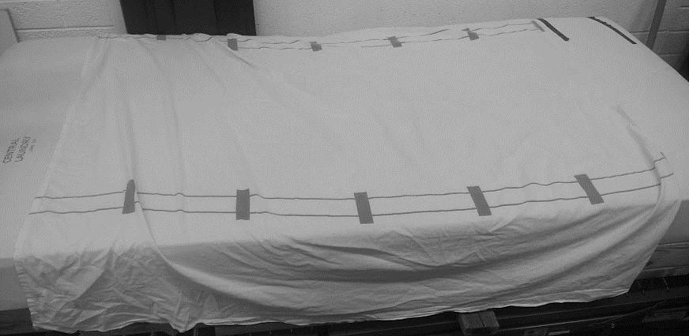
The order of device presentation was randomized. The three devices included a standard Cotton sheet, an AirPal® patient transfer system device (short), and a Skil-Care™ Super-Sling 4-Handles Transfer Sling, as depicted in Figure 1. Participants completed a series of nine transfers, three with each device at the maximal bed height. Motion and force plate data were filtered using a low-pass Butterworth filter with a 10 Hz cutoff frequency. The frame with peak hand force was identified, and this single frame was used for further analysis. Custom MATLAB code was used to compute planar angles and estimate hand forces as specified by 3DSSPP. The data were then processed by 3DSSPP, which provided specific information regarding peak L4-L5 and L5-S1 compression and shear joint forces. The average of the three boosts was calculated for each sheet type, and comparisons of peak forces followed.
Figure 1. Cotton Draw Sheet Used in this Study.
Statistical analysis
Low back compression and shear forces during the three conditions were analyzed using a one-way ANOVA followed by a Tukey test for pairwise comparisons.
Results
There were significant differences in low back forces when comparing the boosting task with the three friction-reducing devices. The comparison showed that the AirPal® reduced low back forces most effectively compared to the Cotton sheet and the Skil-Care™. Surprisingly, the Skil-Care™ produced the greatest peak low back forces and was not statistically different from the Cotton sheet. The specific results of the comparisons can be found in Table 1.
Table 1. Various Peak Low Back Forces Between Sheet Types
|
Force Location and Direction |
Sheet 1 |
Mean (N) |
Standard Error |
Sheet 2 |
Mean (N) |
Standard Error |
Mean Difference (N) |
Standard Error |
p-value |
|---|---|---|---|---|---|---|---|---|---|
|
L4-L5 Compression |
Skil-Care™ |
3510 |
165 |
AirPal® |
2495 |
476 |
1014 |
151 |
< .0001* |
|
Cotton |
3479 |
172 |
AirPal® |
2495 |
476 |
983 |
151 |
< .0001* |
|
|
Cotton |
3479 |
172 |
Skil-Care™ |
3510 |
734 |
–29.8 |
151 |
0.9892 |
|
|
L4-L5 A–P Shear |
Skil-Care™ |
97.9 |
18.5 |
AirPal® |
99.6 |
14.3 |
–1.92 |
16.7 |
0.9962 |
|
Cotton |
119 |
15.9 |
AirPal® |
99.6 |
14.3 |
23.1 |
16.7 |
0.6810 |
|
|
Cotton |
119 |
15.9 |
Skil-Care™ |
97.9 |
18.5 |
21.3 |
16.7 |
0.6289 |
|
|
L4-L5 Lateral Shear |
Skil-Care™ |
124 |
10.1 |
AirPal® |
79.6 |
7.61 |
44.5 |
8.72 |
0.0014* |
|
Cotton |
132 |
8.32 |
AirPal® |
79.6 |
7.61 |
52.5 |
8.72 |
0.0001* |
|
|
Cotton |
132 |
8.32 |
Skil-Care™ |
124 |
10.1 |
7.83 |
8.72 |
0.8028 |
|
|
L5-S1 Compression |
Skil-Care™ |
2864 |
158 |
AirPal® |
1882 |
94.3 |
983 |
142 |
< .0001* |
|
Cotton |
2798 |
165 |
AirPal® |
1882 |
94.3 |
916 |
142 |
< .0001* |
|
|
Cotton |
2798 |
165 |
Skil-Care™ |
2865 |
158 |
-66.7 |
142 |
0.9386 |
|
|
L5-S1 A–P shear |
Skil-Care™ |
472 |
23.8 |
AirPal® |
407 |
18.3 |
63.2 |
21.8 |
0.1042 |
|
Cotton |
458 |
22.8 |
AirPal® |
407 |
18.3 |
49.4 |
21.8 |
0.2453 |
|
|
Cotton |
458 |
22.8 |
Skil-Care™ |
472 |
23.8 |
–13.7 |
21.8 |
0.8968 |
|
|
L5-S1 Lateral Shear |
Skil-Care™ |
22.6 |
3.83 |
AirPal® |
20.6 |
3.20 |
0.431 |
3.40 |
0.9956 |
|
Cotton |
20.2 |
3.13 |
AirPal® |
20.6 |
3.20 |
–2.38 |
3.40 |
0.8744 |
|
|
Cotton |
20.2 |
3.13 |
Skil-Care™ |
22.6 |
3.67 |
–1.94 |
3.40 |
0.9140 |
* indicates a significant difference between the sheet types.
There were also significant differences in hand forces when comparing the different categories that are consistent with the differences in low back forces such that the AirPal® was the best performing and the Skil-Care™ had the highest force as seen in Table 2.
Table 2. Peak Hand Force Between Sheet Types
|
Sheet 1 |
Mean Hand Force (lbs) |
Standard Error |
Sheet 2 |
Mean Hand Force (lbs) |
Standard Error |
Mean Difference |
Standard Error |
p-value |
|---|---|---|---|---|---|---|---|---|
|
Skil-Care™ |
77.8 |
2.53 |
AirPal® |
54.9 |
1.52 |
22.8 |
2.19 |
<.0001* |
|
Cotton |
77.5 |
2.38 |
AirPal® |
54.9 |
1.52 |
22.6 |
2.19 |
<.0001* |
|
Cotton |
77.5 |
2.38 |
Skil-Care™ |
77.8 |
2.53 |
0.27 |
2.19 |
0.9958 |
* indicates a significant difference between the sheet types.
The air-assisted device was the best performing device, effectively reducing most low back forces as well as hand forces up to 34% compared to the other devices.
Discussion
The purpose of this study was to assess which of three patient repositioning devices was most effective at reducing low back and hand forces. The results show that the AirPal® was the most effective of the devices tested in this study for achieving that goal. The results of the current study confirmed the findings of a similar project by Larson et al. (2018). They found that the only effective reduction in force with a simple friction-reducing sheet compared to a Cotton sheet occurred when the friction-reducing sheet was doubled up on itself, creating a double layer of friction-reducing material that can slide against itself rather than against the Cotton sheet. The device used here, the Skil-Care™, is not of sufficient size to be doubled up for the boosting task. These results are also consistent with Hwang et al. (2019), who found that a simple friction-reducing draw sheet did not produce hand force differences compared to a Cotton sheet. That said, direct comparisons between these studies are difficult due to the different patient handling tasks performed (lateral transfer (Hwang et al., 2019) vs. boosting (the current study)). In addition, they used only a force gauge in one hand, which gives a rather incomplete picture of overall force for these patient handling tasks. Lastly, they used “patients” with less mass than the “patient” in the current study, which is less representative of typical inpatients.
Wiggerman et al. (2021) also observed low back forces during patient handling tasks. In their study, they systematically used “patients” of three different weights to assess the effectiveness of various patient handling materials. They showed that there was no significant difference in low back forces when boosting a patient in bed between a typical Cotton draw sheet and a simple friction-reducing device, but that there were significant differences between an air-assisted device and the others in the lightest “patient” category. They also found more pronounced differences in hand forces between the devices as “patient” weight increased. This study used a bed height of the “knuckle height of the caregiver or higher,” which may be lower than optimal.
The lack of difference between the Cotton sheet and the Skil-Care™ in the current study is concerning. The Skil-Care™ purports to be a friction-reducing device (Skil-Care Corporation, 2013), but it does not seem to perform its primary function, as evidenced by high low-back and hand forces when used per the manufacturer’s recommendations. This suggests that using the Skil-Care device still results in large stresses on healthcare workers’ bodies. The low-back compression forces when using the Cotton sheet and the Skil-Care are over the 3400 N recommended limit at L4-L5, which is in line with Kotowski et al. (2019). Kotowski et al. (2019) reported more pronounced overages of the limit, but that may be due to bed height, as the current study did not give participants a choice and set the bed in its highest position, which helps maintain a more neutral posture in the vertebral column.
Even with the best-performing device, the AirPal®, average hand forces were above the recommended lifting limit of 35 pounds. The lowest hand force recorded was 37 pounds, with an average of 54.9 pounds using the AirPal®. This shows that while it is better than the other devices in this research study, it is still not enough to bring hand force under the recommended limit. With the individual acting as a patient in this study being an average-sized person, this is problematic, as it still places healthcare workers at risk of musculoskeletal injury due to regular patient-handling tasks that are a required part of the job.
Multiple factors influence the decision-making process when healthcare workers choose which materials to use during patient-handling tasks. Perhaps the most prohibitive factor is the cost of air-assisted devices. Prices vary by supplier, but an air supply and a reusable transfer pad together can cost thousands of dollars (Baptiste et al., 2006), a substantial investment per patient. Another factor is the time it takes for healthcare workers to place the equipment under the patient, when in most cases a cotton sheet is already in place (Sampath et al., 2019). Together, these factors often lead administrators and frontline workers to balk at using the equipment when they do not see its value. The value becomes clearer as knowledge of the effectiveness of air-assisted devices becomes more common.
Limitations
The range of bed heights was limited by the bed itself. A bed with a wider range of heights could provide greater insight into the effects of bed height on low back forces and lead to more accurate recommendations in the future.
All participants in the preliminary and main studies lived in the greater Provo, Utah, area, so the results cannot be generalized to a broader population, as there may be regional differences in healthcare education.
There was only one healthy, young individual who served as a patient. This was important as a control factor to make direct comparisons with other factors, but this individual was atypical of a general patient population. Real patients tend to be sickly, older, and less cooperative. This research assistant also represented only one height and weight, whereas genuine patients are much more varied and have individualized differences that can affect patient-handling technique and the caregiver's experience.
Proper boosting should be performed with healthcare workers of similar height. The height difference between participants and the consistent assistant performing the boosting task can therefore be considered a limitation, as there were occasionally stark height differences between them. This limitation was necessary as a control factor to ensure accurate comparisons.
Another limitation of this study was the relatively small sample size. However, the power analysis indicated that this was a sufficient sample size, and the number of participants was consistent with other studies of this type.
Future Research
With new technology emerging frequently, it is important to continue testing all purported friction-reducing devices and to observe how they compare to materials already available and to each other. It is also important for companies that manufacture and sell these materials to test them before distribution to ensure the efficacy of their products. This will continue to inform healthcare workers about the best methods for reducing the risk of work-related musculoskeletal injury.
Incorporating multiple patient-handling techniques and comparing low-back forces across them is also warranted. Techniques include simply bending the patient’s legs and placing their feet on the bed prior to the boosting task, as well as placing the bed at a decline prior to the boost. It would also be important to study the trade-off between low-back and shoulder forces during these patient-handling tasks to determine whether lowering low-back force increases the risk of shoulder injury for healthcare workers, and vice versa.
Another future study could incorporate inclining the bed with the air-assisted device and determine whether there is an angle at which the air overcomes the bed's friction, allowing the patient to slide freely to the edge of the bed, as this would be a safety concern. This idea would require very controlled conditions with healthy individuals to prevent injury.
Implications
This research underscores the importance of using fully vetted patient-handling equipment. This way, healthcare workers can trust the equipment to reduce the forces placed on their bodies. Healthcare is a physically demanding field, and every reduction in force is important for keeping these workers in their chosen fields. They also need to use this equipment with all patients requiring manual handling, not just bariatric patients. In contrast, another implication is that even with best-performing devices, such as air-assisted devices, hand and low-back forces still exceed the recommended limits for repetitive tasks, which is problematic for healthcare workers, as they remain at risk of low-back injury.
Conclusion
Nurses and other healthcare workers are at risk for injury during patient handling. Injuries affect a substantial number of healthcare workers each year and contribute to the shortage of healthcare workers at the bedside. Identifying ways to reduce the risk of injury during patient handling is imperative for healthcare workers and patients. Using assistive technologies may help to reduce the incidence of injury. Still, more research is needed to identify the best available technology and assess its feasibility at the bedside.
Acknowledgements
A special thanks to Lauren Adams and Spencer Peterson for contributing their time and expertise for data collection during this project. Also, a thank you to AirPal® for loaning the air-assisted device used throughout this study.
Authors
Robert E. Larson, OTR, PhD
Email: rolarson@ttuhsc.edu
ORCID ID: 0000-0002-1182-2427
Robert E. Larson earned his PhD from BYU where he worked with the other authors on this paper. Prior to that, he earned his occupational therapy doctorate degree from the University of Toledo where he also picked up a keen interest in safe patient handling. He has published multiple articles in this area and is eager to continue in this line of research.
Dustin A. Bruening, PhD
Email: dabruening@byu.edu
ORCID ID: 0000-0003-3815-6089
Dustin A. Bruening graduated with a PhD from the University of Delaware and has extensive training in biomechanics research, which was especially important when laying the foundation for the current project when delving into the procedures for collecting and processing data.
Sarah T. Ridge, PhD
Email: sarah_ridge@byu.edu
ORCID ID: 0000-0002-1975-0181
Sarah T. Ridge earned her PhD from the University of Delaware in biomechanics and had keen input into several foundational aspects of the current study. She directly influenced the formation of this project by giving insight into the processing and interpretation of the data.
Wayne Johnson, PhD, PT
Email: wayne_johnson@byu.edu
ORCID ID: 0000-0002-2207-5826
Wayne Johnson earned his PhD from Brigham Young University and his Physical Therapy degree from the University of Alabama at Birmingham. He has worked extensively researching and teaching about the back and spine and has clinical experience in a variety of settings.
Ulrike H. Mitchell, PhD, PT
Email: rike@byu.edu
ORCID ID: 0000-0002-2298-8756
Ulrike H. Mitchell earned her PhD from Brigham Young University and her first Physical Therapy degree from Krankengymnasikschule Hessisch Lichtenau in Germany. She has taught topics related to the spine for many years and has published some innovative MRI based studies regarding the low back and traction in the past.
References
Baptiste, A., Boda, S. V., Nelson, A. L., Lloyd, J. D., & Lee III, W. E. (2006). Friction-reducing devices for lateral patient transfers: a clinical evaluation. Aaohn Journal, 54(4), 173-180.
Bartnik, L. M., & Rice, M. S. (2013). Comparision of caregiver forces required for sliding a patient up in bed using an array of slide sheets. Workplace Health & Safety, 61(9), 393-400.
Bureau of Labor Statistics [BLS]. (2019). Injuries, illnesses, and fatalities. https://www.bls.gov/iif/oshwc/osh/case/cd_r10_2018.htm
Davis, K. G., & Kotowski, S. E. (2015). Prevalence of musculoskeletal disorders for nurses in hospitals, long-term care facilities, and home health care: a comprehensive review. Human factors, 57(5), 754-792.
Frost, L., & Barkley, W. M. (2012). Patient handling methods taught in occupational therapy curricula. American Journal of Occupational Therapy, 66(4), 463-470.
Hwang, J., Kuppam, V. A., Chodraju, S. S. R., Chen, J., & Kim, J. H. (2019). Commercially available friction-reducing patient-transfer devices reduce biomechanical stresses on caregivers’ upper extremities and low back. Human factors, 61(7), 1125-1140.
Kanaskie, M. L., & Snyder, C. (2018). Nurses and nursing assistants decision-making regarding use of safe patient handling and mobility technology: A qualitative study. Applied Nursing Research, 39, 141-147.
Kotowski, S. E., Davis, K. G., & Marras, W. S. (2019). Effectiveness of friction-reducing patient-handling devices on reducing lumbosacral spine loads in nurses: A controlled laboratory simulation study. International Journal of Safe Patient Handling & Mobility, 9(2).
Larson, R. E., Murtagh, E. M., & Rice, M. S. (2018). Forces involved when sliding a patient up in bed. WORK: A Journal of Prevention, Assessment, and Rehabilitation, 59(3), 439-448. https://doi.org/10.3233/WOR-182688
Larson, R. E., Rice, Martin S. (2015). Hand forces involved when completing a lateral bed to plinth transfer. International Journal of Safe Patient Handling & Mobility, 5(3), 117-121.
Lloyd, J. D., & Baptiste, A. S. (2006). Friction-reducing devices for lateral patient transfers: A biomechanical evaluation. American Association of Occupational Health Nurses, 54(3), 113-119.
Nelson, A., Powell-Cope, G., Gavin-Dreschnack, D., Quigley, P., Bulat, T., Baptiste, A. S., Friedman, Y. (2004). Technology to promote safe mobility in the elderly. Nursing Clinics of North America, 39(3). https://doi.org/10.1016/j.cnur.2004.05.001
Rice, M. S., Dusseau, J. M., & Miller, B. K. (2011). A questionnaire of musculoskeletal injuries associated with manual patient lifting in occupational therapy practitioners in the state of Ohio. Occupational Therapy in Health Care, 25(2-3), 95-107.
Sampath, S. L., Wilson, K., Davis, K., & Kotowski, S. (2019). Reality of safe patient handling policies and programs in hospitals across the United States. International Journal of Safe Patient Handling & Mobility. 9(2), 69-76.
Skil-Care Corporation. (2013). Transfer Slings. https://skil-care.com/catdetail/cat?parcat=Transfer%20Slings&scat=111&pid=248#.X5rZu4hKjIU
Slusser, L. R., Rice, M. S., & Miller, B. K. (2012). Safe patient handling curriculum in occupational therapy and occupational therapy assistant programs: A descriptive study of school curriculum within the United States of America. Work, 42(3), 385-392.
Suliman, M. (2018). Prevalence of low back pain and associated factors among nurses in Jordan. Nursing forum, 53(4) 425-431.
Tang, L., Wang, G., Zhang, W., & Zhou, J. (2022). The prevalence of MSDs and the associated risk factors in nurses of China. International Journal of Industrial Ergonomics, 87.
Waters, T. R., Putz-Anderson, V., Garg, A., & Fine, L. J. (1993). Revised NIOSH equation for the design and evaluation of manual lifting tasks. Ergonomics, 36(7), 749-776.
Waters, T., Collins, J., Galinsky, T., & Caruso, C. (2006). NIOSH research efforts to prevent musculoskeletal disorders in the healthcare industry. Orthopaedic Nursing, 25(6), 380-389.
Wiggermann, N., Zhou, J., & McGann, N. (2021). Effect of repositioning aids and patient weight on biomechanical stresses when repositioning patients in bed. Human factors, 63(4), 565-577.

