



Medical Aid in Dying (MAID) is the practice in which terminally ill, mentally capable adults can voluntarily request prescribed medication to be self-administered in order to end their life in a peaceful manner. The MAID process involves a multidisciplinary team of healthcare professionals who provide ongoing clinical care, assessment, and support over the several weeks to months during which a patient goes through the process to obtain and potentially self-administer MAID medications. MAID has been authorized in the United States for nearly 30 years, since the enactment of the Death with Dignity Act in 1997 in Oregon. As more states authorize MAID, remove residency restrictions, and expand prescribing authority to APRNs, it is imperative that all nurses have current knowledge about laws and clinical practice guidelines for patients seeking MAID. This article offers an overview of the history and process of MAID in the United States, a discussion of attitudes and ethical code and position statements from several professional healthcare organizations, and considerations for nurses who are employed in states with and without legislation to support MAID.
Key Words: Medical Aid in Dying, MAID, terminal illness, death, Death with Dignity, ethics, ethical code, ANA Code of Ethics, professional organization, position statement
Medical Aid in Dying (MAID) is the practice in which terminally ill, mentally capable adults can voluntarily request prescribed medication to be self-administered in order to end their life in a peaceful manner (Quill & Sussman, 2023). Far from a singular transaction between physician and patient, the MAID process involves a multidisciplinary team of healthcare professionals who provide ongoing clinical care, assessment, and support over the several weeks to months during which a patient goes through the process to obtain and potentially self-administer MAID medications. MAID has been authorized in the United States for nearly 30 years, since the 1997 enactment of the Death with Dignity Act in Oregon. As more states authorize MAID, remove residency restrictions, and expand prescribing authority to APRNs, it is imperative that all nurses have current knowledge about laws and clinical practice guidelines for patients seeking MAID.
MAID has been authorized in the United States for nearly 30 years, since the enactment of Oregon’s Death with Dignity Act in 1997
Medical Aid in Dying in the U.S.
As of June 2025, MAID is legally authorized in the following ten U.S. jurisdictions: Oregon, Washington, Vermont, California, Colorado, Hawaii, New Jersey, Maine, New Mexico, and the District of Columbia (Compassion & Choices, 2025). Additionally, although Montana lacks a formal legislative framework, the state has permitted the practice through the 2009 Baxter v. Montana state Supreme Court ruling, (Baxter v. Montana, 2009). Delaware recently enacted MAID legislation, with implementation scheduled for January 2026 (Delaware General Assembly, 2025). The Illinois bill was signed in December 2025 and will be implemanted in Septemebr2026 (Death with Dignity, 2026). New York passed a bill that is currently awaiting the governors’ signature (Aiello, 2025).
The History of MAID in the U.S.
During the 1970s, societal attitudes began to shift toward greater recognition of individual rights in healthcare, including end-of-life decisions. Changes in the cultural landscape laid the groundwork for later arguments that people should have control over how and when they die, especially when facing incurable terminal illness. An example of this can be seen in the pivotal 1976 New Jersey Supreme Court case In re Quinlan (1976). Karen Ann Quinlan was a young woman in a persistent vegetative state, and her parents sought to remove her from ventilator support. The court ruled that individuals have a constitutional right to refuse life-sustaining treatment, even if doing so results in death (In re Quinlan, 1976).
During the 1970s, societal attitudes began to shift toward greater recognition of individual rights in healthcare, including end-of-life decisions.
California became the first state to create a pathway for patients to refuse life-prolonging treatment via an advance directive through the Natural Death Act of 1976 (Jonsen, 1978). Adults could sign a formal “declaration” requesting that no extraordinary life-prolonging procedures be used if they became terminally ill and unable to communicate and physicians were legally protected when following the patient's written instructions. Several states followed suit and passed Natural Death Laws in the years immediately following California’s example (Jonsen, 1978).
Public awareness about end-of-life care continued throughout the 1980s and into the early 1990s. Hospice services, modeled after Dame Cicely Saunders’ work, expanded in the United States with the addition of the Medicare hospice benefit in 1982 (Davis, 1988; Kings College London, n.d.; Saunders, 1990). Although this did not legalize aid in dying, it further increased awareness about end-of-life care and options as the program grew and expanded.
The Hemlock Society, founded in 1980 by Derek Humphry (2002), was a pioneer in right-to-die advocacy in the United States. The society aimed to promote public awareness, patient autonomy, and legal rights related to voluntary euthanasia and physician-assisted death. Through education campaigns and publications like Humphry’s book Final Exit (Humphry, 2002), the Hemlock Society played a pivotal role in bringing end-of-life issues into the public dialogue and advancing legislative efforts that culminated in Oregon’s landmark Death with Dignity Act of 1994 (Oregon Health Authority, n.d.), which was enacted in 1997. The organization largely dissolved in 2003, although one chapter remains in San Diego, CA (Humphry, 2021).
The addition of authorized states has been a gradual process over the past 30+ years...
The addition of authorized states has been a gradual process over the past 30+ years, although the number of states that introduced bills and authorized MAID increased after 2014, when the story of Brittany Maynard received national attention. Brittany was a 29-year-old with a terminal diagnosis of glioblastoma. She had to move from her home in California to Oregon to access MAID, and at the time, it was said that her unique story would likely impact legislatures (Peralta, 2014). Since 2016, seven states have enacted laws (not including Delaware, Illinois, and New York), and several states have introduced and passed improvement bills to reduce barriers to accessing the resources required to obtain MAID.
The Process of Obtaining MAID
In every U.S. jurisdiction where MAID is authorized, patients must meet specific eligibility criteria per the law. These criteria include: a) being an adult aged 18 or older; b) having a terminal illness with a prognosis of six months or less to live, confirmed by two qualified healthcare providers (physicians, and in some states, advanced practice registered nurses [APRNs] and physician assistants); c) possessing medical decision-making capacity; and d) having the ability to self-administer the prescribed medication. In every U.S. jurisdiction where MAID is authorized, patients must meet specific eligibility criteria per the law. Patients must also be residents of the state where MAID is legal, although recent legislative updates in Oregon and Vermont have removed state residency requirements for access to MAID (Shavelson et al., 2023). Refer to Table 1 for a list of medical aid in dying laws for access to state-specific language.
Table 1. Medical Aid in Dying Laws in the United States
|
State |
Name of Law with link to state health authority (for information and to download required forms) |
Act/Ballot # |
Passed |
Enacted |
|---|---|---|---|---|
|
Oregon |
Ballot Measure 16 |
1994-Ballot |
1997 |
|
|
Washington |
Initiative 1000 |
2008-Ballot |
2009 |
|
|
Montana |
Allowed by State Supreme Court Decision: Baxter v. Montana lawsuit |
2009 |
||
|
Vermont |
Act 39 |
2013-Legislature |
2013 |
|
|
California |
ABX2-15 |
2015-Legislature |
2016 |
|
|
Colorado |
Proposition 106 |
2016-Ballot |
2016 |
|
|
Washington, D.C. |
D.G. ACT 21-577 |
2016-DC Legislature |
2017 |
|
|
Hawaii |
HB 2739 |
2018-Legislature |
2019 |
|
|
New Jersey |
A1504 |
2019-Legislature |
2019 |
|
|
Maine |
LD 1313 |
2019-Legislature |
2019 |
|
|
New Mexico |
HB 47 |
2021-Legislature |
2021 |
|
|
Delaware |
Ron Silverio/Heather Block End of Life Options Act |
HB 140 |
2025-Legislature |
2025 |
|
Illinois |
End-of-Life Options for terminally Ill Patients Act |
Act SB1950 |
2025 |
9/2026 |
|
New York |
Pending legislation |
2026 |
||
In most jurisdictions, patients are required to submit three requests to the attending or prescribing provider...
Except for Montana, each U.S. jurisdiction that authorizes MAID has enacted statutes generally modeled on Oregon’s original Death with Dignity Act. However, legal provisions—such as waiting periods, authorized prescribers, and documentation requirements—vary significantly across states. In most jurisdictions, patients are required to submit three requests to the attending or prescribing provider: two verbal requests and one written request. The written request must be witnessed by two individuals, and most states place restrictions on who may serve as a witness (e.g., prohibiting relatives, beneficiaries, or healthcare providers involved in the patient's care). The verbal requests typically must be separated by a mandatory waiting period, which can be as long as 15 days, depending on the state. Although these provisions may act as a barrier to accessing care, these are safeguards to ensure that vulnerable individuals are not coerced into receiving MAID (Compassion & Choices, 2022).
Understanding Attitudes towards MAID
As a growing number of jurisdictions permit MAID, nurses will increasingly face questions from patients and families about this option. In addition to being knowledgeable about the laws and process of obtaining MAID, understanding moral arguments both for and against MAID is essential.
All of these decisions reflect individual morality, values, and religious or existential beliefs.
All end-of-life decisions are unquestionably complex, whether centered on use or discontinuation of life-supporting medical interventions, access to palliative care or hospice, or myriad personal and practical issues such as how to best communicate with loved ones or complete financial preparation. All of these decisions reflect individual morality, values, and religious or existential beliefs. It is not surprising, then, that attitudes towards MAID vary widely, ranging from strong opposition to committed support. Understanding of the major arguments for and against MAID can assist nurses to evaluate their own position on this topic and be helpful to inform thoughtful discussion with others.
Autonomy
The most fundamental justification for allowing competent individuals to control the timing and circumstances of their death rests on the principle of autonomy, or the right to self-determination. Closely related to the concept of liberty, autonomy is the right to live your life in your own way, according to your own values and preferences (Jennings, 2007). Like all claims to rights, it is limited only by the requirement that others are not harmed by your exercise of choices. Margaret Battin, one of the earliest and strongest proponents of MAID, argues that the right to decide to request and enact MAID is a fundamental human right and thus constitutes human dignity (Battin, 1994).
The most fundamental justification for allowing competent individuals to control the timing and circumstances of their death rests on the principle of autonomy
In healthcare, the autonomous right to provide or withhold consent for medical procedures requires that the person providing consent be fully capable of making informed choices. In the United States, this strict requirement also applies to requests for MAID. Nevertheless, there is concern that, once we permit competent adults to choose MAID, restrictions gradually will be loosened and lead to fewer safeguards, ultimately allowing what would then be euthanasia of persons lacking capacity, such as children or adults with dementia. This is termed a “slippery slope” argument (O’Rourke et al., 2017).
Slippery slope arguments are a well-recognized logical fallacy but can be emotionally persuasive. These concerns can be minimized by pointing out that there are numerous laws concerning end-of-life care in place, including those regarding informed consent for or refusal of all medical interventions, and none of these laws have changed over decades. In addition, data from states that have legislation permitting MAID have provided no evidence of abuse (Hoffman & Beer, 2023).
A further concern, even by those who recognize that competent adults have the right to make all end-of-life decisions, is the worry that participating in an act that leads to a patient’s death is a form of killing, contrary to fundamental duties and commitments of both the medical and nursing professions. The specific reasoning behind the concern is that, when life-sustaining medical interventions are withdrawn, the cause of death is the underlying terminal illness, but when medical aid in dying is provided, the cause of death could be construed as the specific act of providing a lethal medication dose (O’Rourke et al., 2017). Supporters of MAID point out that, while this is a distinction, it is without a meaningful difference.
Critical care nurses are very familiar with situations in which life-prolonging interventions, particularly mechanical ventilation and vasopressors, are withdrawn from a terminally ill patient or one who (or whose surrogate) has refused continued use of these treatments. Many patients will begin to actively die immediately when the intervention is withdrawn. In these situations, just as in MAID, clearly the action of the clinician, be it physician, nurse, or respiratory therapist, is a proximate or immediate action that is followed by the patient’s death. Importantly, the actions, both in MAID and treatment withdrawal, would not take place if the patient were not dying of an illness and had not requested the act. In fact, in most states, the terminal diagnosis is listed on death certificates as the cause of death.
Professional Ethical Commitments
Perhaps more complex is the belief that the ethics of medicine, as originally recorded in the Oath of Hippocrates, prohibit MAID. The long-standing convention of many medical schools still includes the recitation of the Oath by students upon graduation. The original version includes the statement: “I will neither give a deadly drug to anybody who asks for it nor will I make a suggestion to this effect” (Hajar, 2017, table 1). More recently, the Oath has been revised and updated. It no longer includes that statement. Instead, is the following: “I will remember that there is an art to medicine as well as science, and that warmth, sympathy, and understanding may outweigh the surgeon's knife or the chemist’s drug” (Hajar, 2017, Table 2 point 4, as written by Louis Lasagna). Despite any change in the Oath, there remains deep discomfort on the part of many physicians in taking part in an act that directly leads to death. As recently as 2017, the American College of Physicians’ position statement did not support legalization of “physician-assisted suicide,” citing concerns that it violates the professions’ ethical commitments (Sulmasy & Mueller, 2017). Earlier versions of the Code of Ethics for Nurses similarly contained the statement that, “…nurses may not act with the sole intent of ending a patient’s life…” (American Nurses Association [ANA], 2001, p. 8).
Despite any change in the Oath, there remains deep discomfort on the part of many physicians in taking part in an act that directly leads to death.
Ethical codes and position statements in both the nursing and medical professions have since been revised to permit participation in MAID. In terms of the ethical duty to relieve suffering, there is clear consensus among both professions that there is an obligation to do everything within one’s power to relieve that suffering (Lawry, 2023; Quill & Sussman, 2023). In response, opponents of MAID claim that improved access to hospice and palliative care would obviate requests for hastening death (Hoffman & Beer, 2023). This is an understandable premise given limited resources in some settings. However, there are very consistent data from jurisdictions where MAID is legal that the large majority of patients in the United States who have accessed MAID are, in fact, already enrolled in hospice (Strand et al., 2023).
While all professionals have the right to express conscientious objection to participate in acts that violate their personal moral code, this right does not permit leaving the patient without alternative care arrangements. The prohibition against abandonment, both physical and emotional, entails the duty to assure patients who request MAID that their views are respected and that their providers will continue to care about them as well as assure care for them and their families (ANA, 2025).
Justice and Discrimination
Opposition to MAID has been particularly strong from those concerned with protecting the rights of persons with disabilities and advocating to reduce the many forms of discrimination still prevalent in our society (Lund, 2025). Disability advocates argue that the assumption that some lives, altered by physical limitations, are not fundamentally worth living devalues those with disabilities who choose to and succeed in living full and meaningful lives (Kious, 2024). It is seen as contributing to “ableism” or the belief that typical or “able-bodied” individuals are superior to those who have functional limitations (Lund, 2025).
In response to these concerns, MAID supporters point out that in the United States, no jurisdiction permits MAID solely on the basis of disability, even if requested by a person with disability who is not terminally ill. In fact, there are contrary concerns raised by MAID advocates that the requirement that the person must be able to independently ingest the lethal medication is an actual form of discrimination against those unable to do this, such as persons with Amyotrophic Lateral Sclerosis (ALS) or major stroke (Shavelson et al., 2025). However, a federal judge has ruled that allowing doctors to assist such patients would “fundamentally alter” the law in which self-ingestion is a primary safeguard (Dinzeo, 2022).
Religious Beliefs
Not surprisingly given the cultural heterogeneity of the United States, there are a variety of formal positions from organized religions and in personal religious or faith-based attitudes towards MAID (PEW Research Center, 2013). Many of these reflect beliefs about the intrinsic value of every life, the obligation to allow one’s God or higher power to control living and dying, and sometimes the meaning and value of suffering. Unlike the previous arguments summarizing common reasons for opposition or support of MAID, religious beliefs are not subject to logical analysis nor debate. But, recognizing the strong influence of these beliefs, health professionals faced with the obligation to educate patients about end-of-life options must start with understanding of the patient and family’s spiritual belief system (Daaleman & Vandecreek, 2000). As with the arguments summarized above, nurses should be prepared to have thoughtful discussions about MAID without any intention to persuade or convince patients who are seeking information or expressing personal beliefs.
...nurses should be prepared to have thoughtful discussions about MAID without any intention to persuade or convince patients who are seeking information or expressing personal beliefs.
Application to Nursing
Caring for patients who are considering or pursuing MAID often requires a multidisciplinary approach. Any member of the healthcare team may be asked about MAID, and all team members should be prepared to respond appropriately and with respect to their role and institutional policy.
Nurses play a critical role throughout the MAID process. They should have a clear understanding of the steps involved to obtain and self-administer MAID medication, as well as the associated clinical and ethical considerations. This includes ongoing assessment of the patient’s condition, symptom management, emotional and psychosocial support, and bereavement care for family and caregivers. Nurses must also be familiar with the policies of their organization regarding MAID participation, including any restrictions on their involvement (ANA, 2019; Hospice & Palliative Nurses Association, 2024).
Any member of the healthcare team may be asked about MAID, and all team members should be prepared to respond appropriately...
Even in settings where institutional policy limits clinician participation in MAID, it remains essential for nurses to advocate for ongoing, evidence-based education within interdisciplinary teams. This ensures that staff are informed about the legal status of MAID in their jurisdiction and are equipped to respond to patient inquiries with respect, accuracy, and professionalism. This is especially important for travel nurses, who may be assigned to states where MAID is authorized and where legal requirements may differ from those in their home state.
ANA Code and HPNA Position Statements
As mentioned earlier, over the past 10 years, measures of society’s attitude towards MAID consistently remain positive (Yi, 2024). Combined with the growing number of states that have passed legislation permitting MAID, professional organizations, including the ANA and American Medical Association, have recognized the need for guidance regarding what was formerly seen as a conflict between professional ethics and duties to relieve suffering and to respect patient choice. Codes of ethics and formal position statements have gradually shifted to consider participation in aid in dying to be a matter of personal morality. For example, the 2024 position statement from the Hospice and Palliative Nursing Association (HPNA) states the following:
HPNA adopts a stance of engaged neutrality regarding whether MAiD should be legally permitted or prohibited. All hospice and palliative nurses should develop competence and mastery regarding MAiD in the domains of education, clinical practice, research, advocacy, and leadership. Nurses willing to participate in providing care to patients as they consider and/or complete aid in dying should have the educational and organizational support they need to provide attentive care to these dying patients, as they would any other dying patient (HPNA, 2024, para.6).
Codes of ethics and formal position statements have gradually shifted to consider participation in aid in dying to be a matter of personal morality.
The statement continues to address the right of nurses to refrain from participation when their personal beliefs conflict with taking part in MAID:
If a nurse is practicing in a jurisdiction where MAiD is legal and feels morally unable to provide care for a patient requesting MAiD, they may practice conscientious objection and not take part in care that compromises their moral integrity. While any nurse has the option to opt out of assisting patients interested in Medical aid in Dying, HPNA supports the nursing practice of supplying information and psycho-social support to any interested individual seeking information or to obtain MAiD within the practice guidelines of their state’s governing body. The nurse is obligated to make certain that the patient and family are not abandoned and that they continue to receive high-quality palliative care (HPNA, 2024, para.9).
The most recent ANA Code of Ethics for Nurses (ANA, 2025) offers similar guidance, although the precise language is less clear. Interpretive Statement 1.4 addresses the various practical applications of Provision 1: “The nurse practices with compassion and respect for the inherent dignity, worth, and unique attributes of every person” (ANA, 2025, Provision. 1). This states:
Nurses assist recipients of care in reflecting on end-of-life decisions. Resuscitation status, advance directives, withholding and withdrawing life-sustaining treatment, palliative care, medical aid in dying, and foregoing nutrition and hydration require careful consideration. Nurses promote advance care planning conversations and should be knowledgeable about the benefits and limitations of various advance directive documents. The nurse provides interventions to relieve pain and other symptoms in the dying patient consistent with palliative care practice standards and may not act with the sole intent to end life (ANA, 2025, provisions 1.4, para. 3).
Nurses promote advance care planning conversations and should be knowledgeable about the benefits and limitations of various advance directive documents.
Specifying the prohibition to acting with the “sole intent to end life” in provision 1.4 thus permits nurses to participate in acts that are primarily intended to respect patient choice and to relieve suffering - the central ethical justifications for MAID. The additional requirement to provide care “consistent with palliative care standards” is met both by the HPNA statement itself and its consistency with the position of the American Academy of Hospice and Palliative Care Medicine (AAHPM). The AAHPM states:
AAHPM takes a position of studied neutrality on the subject of whether PAD (Physician Assisted Death) should be legally permitted or prohibited….Physicians practicing in jurisdictions in which PAD is legally permitted should never be obligated to participate in PAD if they hold moral or professional objections, nor should they be prohibited from participating within parameters defined by relevant statutes and terms of employment (AAHPM, 2025, section Statement, Paras. 2 & 4).
Considerations for Unauthorized and Authorized States
Unauthorized States
In states without MAID laws, nurses should expect questions and be knowledgeable about how the laws work. With access becoming more common and more people utilizing them, patients may know someone who has completed MAID or may want access themselves (Kozlov et al., 2025).
In states without MAID laws, nurses should expect questions and be knowledgeable about how the laws work.
Patients may request information using a variety of terms like Medical Aid-in-Dying, Death with Dignity, or Assisted Suicide (Gross, 2023). There are also anecdotal reports of vague questions such as, Isn’t there just a pill the doctor can give me to get this over with? No matter the phrase, making it clear that their state does not allow Medical Aid-in-Dying is the first step in the discussion, but not the last. This inquiry must be used as an opportunity to further evaluate their desired goals for end-of-life care to match patients with appropriate care and healthcare team members to meet their needs.
By asking a question about MAID, patients are acknowledging that they are seriously ill and may understand they are nearing the end of their life. Because death is so rarely discussed, there are barriers to knowledge about the types of care available and decisions that may be made. People may not understand that they may decide to stop treatment or not start life-extending treatment, and that making these decisions then requires supportive care through palliative or hospice care. Advance care planning can also be utilized to ensure healthcare wishes are respected if they are no longer able to make decisions for themselves.
Patients may not know how to access hospice or how it works. Exploring any prior experiences with hospice among family and friends helps to start the discussion. If necessary, nurses can help to dispel incorrect information about care that was given. Occasionally, patients have never heard of hospice and are receptive once they understand the goal of focusing on quality of life while no longer receiving curative treatment. Patients may also be unaware that they can interview hospice organizations to find the best match for their needs, if more than one hospice organization is available.
By asking a question about MAID, patients are acknowledging that they are seriously ill and may understand they are nearing the end of their life.
An individual may be extremely motivated to research the MAID process and travel to a state without a residency requirement (currently Oregon and Vermont). The patient should be guided toward volunteer state organizations that detail the timeline involved and the steps required to qualify (See Table 2). They may also connect with a healthcare provider who participates through the Academy of Aid-in-Dying Medicine (2025). Patients must also understand that they must complete each step in the state they choose because healthcare practitioners may not practice via telemedicine in states in which they are not licensed and where MAID is not authorized. The patient must stay in Oregon or Vermont to take the medication; it may be illegal to return with it to their home state.
Table 2. U.S. Organizations with Clinical or Volunteer Information about Medical Aid in Dying
|
Clinical Information:
|
|
National Information:
|
|
State Volunteer Organizations:
|
Ensuring people get the care that meets their needs, including possibly going to an authorized state with a law, is important. MAID laws were developed specifically because dying patients wanted access to a safe and guaranteed way to die peacefully by taking prescribed medications (Stutsman, 2013). Outside of this option, sometimes terminally ill patients end their lives violently using a gun (Schuur, 2022). This increases trauma for those who discover them, adding terrible circumstances to an already sad and difficult time. Or people use other means, like taking stockpiled medications (Stutsman, 2013). This may result in injury rather than death and require emergency care, thus further complicating the end of their lives when they were seeking to control their death. Nurses can evaluate patients’ fears and needs to possibly avoid these tragic actions.
It is prudent for nurses to evaluate their own employing healthcare system to confirm or develop policies and procedures that allow and support the dissemination of such knowledge. For example, if a patient asks a question about MAID in a critical care setting, is that considered a trigger for a psychiatric evaluation and possible suicide watch or is a referral made to a knowledgeable palliative care team for an end-of-life goals evaluation in order to create a plan of care? Leaders in some health systems do not address issues that have not been authorized in their state. Yet some evidence has pointed to the reality that people are ending their own lives when terminally ill in ways that may have been avoided if they had access to quality end-of-life care.
It is prudent for nurses to evaluate their own employing healthcare system to confirm or develop policies and procedures that allow and support the dissemination of such knowledge.
Using Ohio as an example, in 2024 “in Stark County, Ohio, the coroner's office ruled at least 71 deaths as suicides. The Canton Repository, part of the USA TODAY Network, found that in as many as 10 of those cases the suicide was completed by someone who was terminally ill or had been living with chronic physical pain” (Botos, 2025). In 2022, Ohioan Ann Schuur shared the story of her father in the Cincinnati Enquirer. He was 83 years old and had Stage 4 cancer that was complicated by chronic obstructive pulmonary disease (COPD). Schuur, who is a retired hospice social worker, went home from caring for him one night and came back to find that he had ended his life with a gun. She wrote,
I'm at peace with my father's decision. I am not at peace with his means of dying.
If he had lived in Washington, D.C., Oregon, Maine or one of the other seven states that permit medical aid in dying, a physician could have prescribed life-ending medication that would’ve allowed him to go peacefully and in comfort, at a time of his choosing, surrounded by those who loved him. Instead, he died violently and alone, and his family had to deal with the trauma of finding him, (which he orchestrated to be as easy on us as possible) (Schuur, 2022, para. 2-3).
Finally, in states that do not authorize MAID, nurses can be an important voice by becoming active in advocacy. They can speak in support of laws that have the established safeguards previously discussed that allow autonomy at the end of life for patients with a terminal illness.
...in states that do not authorize MAID, nurses can be an important voice by becoming active in advocacy.
Authorized States
Due to significant variation in state laws, it is essential that nurses understand the specific MAID regulations in the state where they practice. In all jurisdictions where MAID is authorized, only the patient is legally permitted to self-administer the prescribed medication—nurses and other clinicians are prohibited from any administration of medications (ANA, 2019). Additionally, even in states where MAID is legal, healthcare organizations may implement internal policies that limit the extent to which clinicians can participate in the process (please refer to Table 1 for state specific laws). Therefore, nurses must be familiar not only with state laws but also with their institutional policies regarding MAID to ensure they practice within both legal and organizational boundaries.
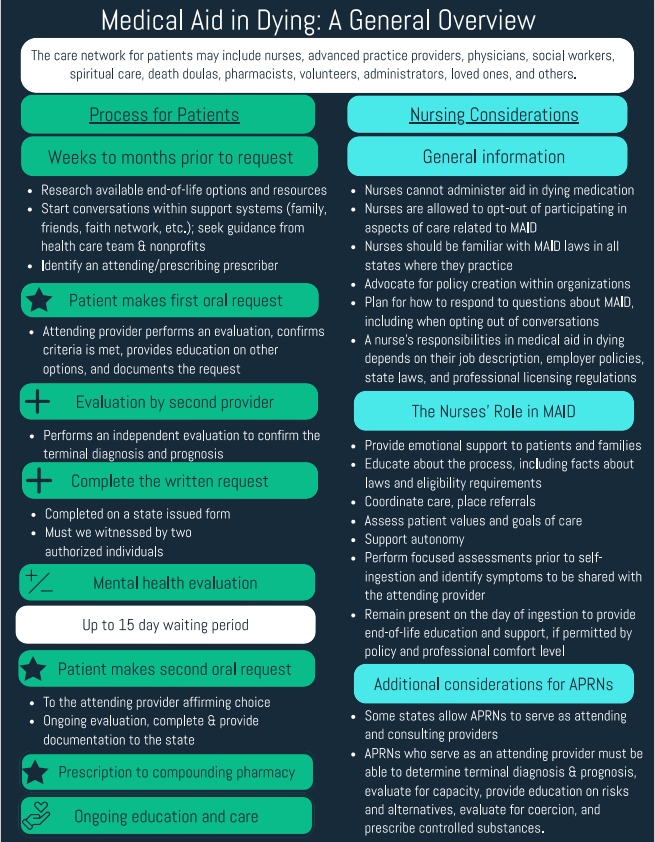
There are several steps involved for a patient to qualify for Medical Aid in Dying that involve making separate requests to a primary provider, being evaluated by a consulting provider, making a written request and then obtaining the medication from a compounding pharmacy. In addition to exploring important considerations for nursing practice, see Table 3, Medical Aid in Dying: A General Overview, which is meant to serve as a visual aid to understand the general process of obtaining MAID, and to provide a printable table for easy reference information for clinical practice.
In all jurisdictions where MAID is authorized, only the patient is legally permitted to self-administer the prescribed medication...
Prescriptive Authority. Four states authorize APRNs, including Nurse Practitioners and Clinical Nurse Specialists, to serve as attending and consulting providers in the MAID process. These states include Colorado, Hawaii, New Mexico, and Washington (Colorado General Assembly, 2024; Hawaii Legislature, 2023; New Mexico Legislature, 2021; Washington State Legislature, 2023) In these jurisdictions, APRNs have full practice authority, including the ability to prescribe controlled substances, which qualifies them to fulfill provider roles under MAID statutes. Notably, in Colorado and Hawaii, two APRNs may act as the attending and consulting provider, without the need for physician consultation (Colorado General Assembly, 2024; Hawaii Legislature, 2023).
Medications. Starting an hour to forty-five minutes prior to ingesting the compounded aid in dying medication, the patient takes a combination of metoclopramide (20mg) and ondansetron (8mg). These prevent nausea and vomiting (Academy of Aid-in-Dying Medicine, 2024). The current, evidence‑based medication protocol for MAID includes five medications: diazepam (1 g), digoxin (100 mg), morphine (15 g), amitriptyline (8 g), and phenobarbital (5 g) – known as DDMAPH. Dosages and medications used may be modified based on patient needs and provider preference. The pure form of the medications (without fillers) is provided as a powder to be reconstituted or a liquid suspension. This regimen replaces older regimens, including secobarbital, which have become obsolete (Macmillan et al., 2025). It is important for patients and clinicians to know that these medications come from compounding pharmacies only; these medications cannot be obtained from general retail pharmacies that are more abundant throughout communities.
Most patients go to sleep within 4-7 minutes after self-administering medications. Although 93% of patients will die in less than 5 hours, it may take longer based on individual patient characteristics (Macmillan et al., 2025). Patients and families should be advised of this possibility and reassured that the patient is comatose, and the signs seen during the active dying phase (e.g., moaning, twitching, changes in respiration) are normal in the dying process.
Patients must self-administer MAID medications via the gastrointestinal tract; however, swallowing is not the only acceptable method. Approved routes of self-administration include oral ingestion, administration through a feeding tube (e.g., gastrostomy or nasogastric tube), via a stoma, or rectally through a rectal catheter. Note that a Macy catheter is not appropriate for MAID medications. Nurses may be asked to place a rectal catheter for the patient. Nurses play a critical role in assessing the patient’s continued ability to use the intended route of administration and should collaborate with the attending provider if an alternative method should be considered to ensure safe and timely access (Shavelson et al., 2023).
Symptom Management. Patients pursuing MAID continue to require comprehensive symptom assessment and management as they are near the end of their life. In accordance with state statutes, patients must be informed of all available care options, including palliative and hospice care. Hospice care is strongly encouraged for patients choosing MAID in order to help with symptom management and complex care needs near the end of life (Academy of Aid-in-Dying Medicine, 2025).
Hospice care is strongly encouraged for patients choosing MAID in order to help with symptom management and complex care needs near the end of life
Nurses play a vital role in assessing and managing symptoms related to the underlying terminal illness (e.g., pain, fatigue, dyspnea) as well as symptoms that may affect a patient's ability to move forward with MAID, including nausea, vomiting, and constipation. Ongoing evaluation of cognitive function and nutritional status, along with the physical strength and mobility required for self-administration of the prescribed medication, is essential. Significant changes should be promptly communicated to the attending provider.
A thorough understanding of pharmacologic strategies to manage symptoms prior to ingestion is crucial to supporting patient comfort and decision-making. In addition, nurses must be aware of the emotional and psychosocial challenges patients and families may face, including anxiety, existential distress, and complex family dynamics, all of which can influence the trajectory of care. Advocacy for timely involvement of interdisciplinary support—such as chaplaincy, social work, and mental health professionals—is key to delivering patient-centered care (Shavelson et al., 2023). In-depth clinician specific education regarding assessments and symptom management, including continuing education offerings, related to the care of aid in dying patients can be found through the Academy of Aid-in-Dying Medicine.
Day of Ingestion. Per Oregon Health Authority (2025) data, patients often choose to ingest the medication in their home or the home of a family member/friend. Depending on institutional policies, they may or may not be allowed to self-administer medications within a hospital, hospice unit, or long-term, assisted, or independent living facilities. Use of hotels is discouraged without prior consent from management. Some home rental groups are seeing owners who are willing to rent their home for this purpose (Waldman, 2025).
If allowed by employer policy, nurses may be present during the dying process to provide emotional support and symptom management. Their responsibilities may include mixing the aid in dying medication, offering comfort measures such as repositioning, modifying the environment for peace and dignity, assisting with personal care, and addressing physical symptoms as appropriate. Nurses also serve as a supportive presence for loved ones, offering guidance about what to expect as death approaches and helping to create a calm, well-informed environment throughout the process. When an end-of-life doula is involved, it is important for nurses to collaborate with the doula to ensure that the patient and family receive coordinated, compassionate care.
Barriers to Care. Patients seeking MAID often face significant barriers that can complicate access to care. While legal and procedural safeguards are designed to ensure safety and accountability, they can be overwhelming—especially for individuals with a very limited life expectancy, minimal resources, complex symptoms, or little social support (Compassion & Choices, 2022; Nguyen et al., 2018). Common challenges may include difficulty identifying a participating provider and navigating required waiting periods (Campbell et al., 2022; Nguyen et al., 2018). Anecdotally, securing qualified witnesses for written request forms is a problematic for socially isolated individuals.
A lack of public awareness and the prevalence of misinformation can further hinder access (Kozlov et al., 2025). Geographic isolation—particularly in rural areas or healthcare deserts—adds logistical challenges, while institutional policies, especially in religiously affiliated health systems, may prevent patients from receiving comprehensive information or referrals (United States Conference of Catholic Bishops, 2018). Nurses are uniquely positioned to identify these barriers and play an important role in advocacy by facilitating access, offering accurate information, and supporting culturally sensitive, patient-centered care throughout the MAID process.
Bereavement & Grief. Death raises a wide range of complex emotions. While research suggests that MAID does not generally result in adverse emotional outcomes for loved ones, there are unique bereavement considerations that nurses should recognize (Ganzini et al., 2009). Additional research is needed in the area of bereavement and loved ones of those who utilize MAID. Anecdotally, some loved ones have shared that they experienced anticipatory grief as they awaited a predetermined death date, or disenfranchised grief if they were unable to share their experience due to stigma or lack of social support. Moral conflict may also arise, particularly when loved ones have mixed feelings about the decision or their role in the process.
Additional emotional stressors can include participating in the preparation of medications, witnessing an unfamiliar and often rapid dying process, or facing scrutiny during interactions with clinicians, coroners, and even law enforcement who are opposed to the option. Nurses should be prepared to offer emotional support and connect families with specialized MAID bereavement resources tailored to their unique needs. Bereavement programs can be found in the Journal of Aid in Dying Medicine article titled, “Bereavement Support Groups for Medical Aid in Dying Family Members” by Gunn et al. (2023).
Moral conflict may also arise, particularly when loved ones have mixed feelings about the decision or their role in the process.
To conclude this section, we include an author created figure that summarizes Medical Aid in Dying with a general overview for quick access. Whether you practice in a state that authorizes MAID or one that does not, we hope that you will find this information useful in the context of the process for patients, and considerations for nurses.
Figure 1.
(ANA, 2019; Colorado General Assembly, 2024; New Mexico Legislature, 2021; Washington State Legislature, 2023)
Conclusion
Within the United States, the legal option of MAID continues to expand, which carries marked implications for nursing practice. Since the passage of Oregon’s Death with Dignity Act, data from jurisdictions such as Oregon, Washington, and California have indicated that patients most often pursue MAID in response to loss of autonomy and a diminished ability to participate in meaningful activities, with uncontrolled physical symptoms cited less frequently (California Department of Public Health, 2025; Oregon Health Authority, 2024; Washington State Department of Health, 2024). These findings underscore the essential role of nurses in supporting values-based decision-making, clarifying patient goals, providing education, conducting comprehensive assessments, and supporting access to high-quality palliative and hospice care.
Within the United States, the legal option of MAID continues to expand, which carries marked implications for nursing practice.
As several states have passed new laws and improvement bills in recent years, it is essential that nurses remain informed about the laws governing MAID in the state where they work, as well as in any jurisdiction where a patient may be seeking care. Nurses are encouraged to consult the exact statutory language in each state to ensure compliance. Since each state law has a different name, again we refer readers to Table 1 for a complete list of names with links to the specific state public health authority website for information about the laws and to download required forms. Most states have nonprofit organizations that provide up-to-date education and resources on their respective laws (refer again to Table 2 for a list of clinical and volunteer organizations).
Finally, as more states consider MAID legislation, we must remain engaged in research, policy development, and education. Equipping nurses with skills to evaluate and communicate successfully with these patients is essential. By doing so, nurses can continue to uphold our professional commitment to patient-centered care—relieving patient-defined suffering and honoring autonomy at the end of life.
Authors
Lisa Vigil Schattinger, MSN, RN
Email: lisavs@ohiooptions.org
Lisa Vigil Schattinger, founder and executive director of Ohio End of Life Options, is an advocate for the U.S. Model of medical aid-in-dying and patient autonomy in end-of-life care. Her professional trajectory began in women's health and evolved into a dedicated focus on supporting terminally ill individuals seeking patient-centered end-of-life options. As board president of the Death with Dignity National Center, she has consistently raised awareness of medical aid-in-dying through advocacy, outreach, and media engagement.
Ashley D. Fry, DNP, APRN, AGACNP-BC, ACHPN
Email: ashleyfrynp@gmail.com
Ashley D. Fry is a palliative care nurse practitioner based in Colorado. Her clinical practice focuses on delivering goal‑concordant care for individuals with serious illness. Her professional background includes health policy, clinician education, and advocacy to expand the role of advanced practice registered nurses in supporting patients who pursue medical aid in dying, including the 2024 updates to Colorado’s End-of-Life Options Act. She aims to advance policies and practices that strengthen nursing leadership and promote patient-centered end-of-life care.
Barbara Daly, PhD, RN, FAAN
Email: bjd4@case.edu
ORCID ID: 0000-0003-1977-5941
Dr. Daly is Professor of Nursing and the Gertrude Perkins Oliva Professor Emerita of Oncology Nursing at Case Western Reserve University School of Nursing. She was the Director of Clinical Ethics at University Hospitals Cleveland Medical Center for 20 years and has extensive experience in leading ethics initiatives as well as providing bedside ethics consultation for patients, families, medical and nursing staff. She has a long-standing program of funded research and a record of publication and presentations to interdisciplinary audiences.
References
Academy of Aid-in-Dying Medicine. (2024). Recommended Aid-in-Dying pharmacology. https://www.aadm.org//wp-content/uploads/2024/12/2024-04-16-Aid-in-Dying-Pharmacology-Recommendation-1.pdf
Academy of Aid-in-Dying Medicine. (2025). Essential information for patients considering medical aid in dying. Home. https://www.aadm.org/patientinfo
Aiello, T. (2025, June 10). New York lawmakers pass medically assisted suicide bill. CBS News New York. https://www.cbsnews.com/newyork/news/new-york-lawmakers-pass-medically-assisted-suicide-bill/
American Academy of Hospice and Palliative Care Medicine. (2025). Physician-assisted dying. Where We Stand. https://aahpm.org/advocacy/where-we-stand/pad/
American Nurses Association. (2019). The nurse’s role when a patient requests medical aid in dying [position statement]. https://www.nursingworld.org/globalassets/practiceandpolicy/nursing-excellence/ana-position-statements/social-causes-and-health-care/the-nurses-role-when-a-patient-requests-medical-aid-in-dying-web-format.pdf
American Nurses Association. (2025). Code of ethics for nurses. ANA. https://codeofethics.ana.org/home
American Nurses Association. (2001). Code of ethics for nurses with interpretive statements. American Nurses Association. https://archive.org/details/codeofethicsforn0000unse
Battin, M. P. (1994). The least worst death: Essays in bioethics on the end of life. Oxford University Press. https://www.amazon.com/Least-Worst-Death-Monographs-Epidemiology/dp/0195082656
Baxter v. Montana, 2009 MT 449, 354 Mont. 234, 224 P.3d 1211 (Mont. 2009). https://compassionandchoices.org/wp-content/uploads/2024/04/091231-sc-opinion-wm-1.pdf
Botos, T. (2025, February 17). Prolific Ohio artist wanted to leave life on her own terms. So she traveled to Switzerland. USA TODAY NETWORK. https://www.usatoday.com/story/news/nation/2025/02/17/assisted-suicide-switzerland-ohio-artist/78634333007/
California Department of Public Health. (2025, July). California end of life option act: 2024 data report. https://www.cdph.ca.gov/Programs/CHSI/CDPH%20Document%20Library/CDPH_End_of_Life_Option_Act_Report_2024.pdf
Campbell, E. G., Kini, V., Ressalam, J., Mosley, B. S., Bolcic-Jankovic, D., Lum, H. D., Kessler, R., & Decamp, M. (2022). Physicians’ attitudes and experiences with medical aid in dying in Colorado: A “hidden population” survey. Journal of Internal Medicine, 37(13), 3310-3317. https://doi.org/10.1007/s11606-021-07300-8
Colorado General Assembly. (2024). Colorado Revised Statutes § 25-48-101 et seq. (As amended by Ch. 406, § 2, 2024, effective Aug. 7 2024). https://leg.colorado.gov/sites/default/files/images/olls/crs2024-title-25.pdf
Compassion & Choices. (2022). Fact: Medical aid in dying laws work to protect patients. https://www.compassionandchoices.org/wp-content/uploads/2020/11/maid-laws-protect-patients_12_15_22.pdf
Compassion & Choices. (2025). States where medical aid in dying is authorized. https://compassionandchoices.org/states-where-medical-aid-in-dying-is-authorized/
Daaleman, T. P. & Vandecreek, L. (2000). Placing religion and spirituality in End-of-Life care. Journal of American Medical Association, 284(19), 2514-2517. https://doi.org/10.1001/jama.284.19.2514
Davis, F. A. (1988). Medicare hospice benefit: Early program experiences. Health Care Financing Review, 9(4), 99-111. https://www.cms.gov/Research-Statistics-Data-and-Systems/Research/HealthCareFinancingReview/List-of-Past-Articles-Items/CMS1192048
Death with Dignity. (2026). Illinois current status: Under threat, legal. https://deathwithdignity.org/states/illiinois/
Delaware General Assembly. (2025). An act to amend Title 16 of the Delaware code relating to end of life options. https://legis.delaware.gov/BillDetail/141725
Dinzeo, M. (2022, June 22). Judge: California aid-in-dying law doesn’t discriminate against the disabled. Courthouse News Service. https://www.courthousenews.com/judge-california-aid-in-dying-law-doesnt-discriminate-against-the-disabled/
Ganzini, L., Goy, E. R., Dobscha, S. K., & Prigerson, H. G. (2009). Mental health outcomes of family members of Oregonians who request physician aid in dying. Journal of Pain and Symptom Management, 38(6), 807–815. https://doi.org/10.1016/j.jpainsymman.2009.04.026
Gross, R., (October 24, 2023). How aid in dying became medical, not moral. The New York Times. https://www.nytimes.com/2023/10/24/science/medical-dying-suicide.html
Gunn, R.A., Uslander, E.M., & Uslander, R.L. (2023). Bereavement support groups for medical aid in dying family members. Journal of Aid in Dying Medicine, 1(1), 71. https://issuu.com/journalofaid-in-dyingmedicine/docs/journal_of_aid-in-dying_medicine_vol1_final
Hajar, R. (2017). The physician’s oath: Historical perspectives. Heart Views, 18(4), 154-159. https://doi.org/10.4103/HEARTVIEWS.HEARTVIEWS_131_17
Hawaiʻi Legislature. (2018). Our Care, Our Choice Act, Hawaiʻi Rev. Stat. §§ 327L-1 et seq. (amended by H.B. 650, 2023). https://health.hawaii.gov/opppd/ococ/
Hoffman, D. N., & Beer, E. (2023). Have arguments for and against Medical Aid in Dying stood the test of time? Voices in Bioethics, 9(2023). https://doi.org/10.52214/vib.v9i.12079
Hospice and Palliative Nurses Association. (2024). HPNA position statement: Medical aid in dying (MAiD). https://www.aadm.org/wp-content/uploads/2025/01/HPNA-statement-2024.pdf
Humphry, D. (2021, September 21). Farewell to hemlock: Killed by its name [blog]. The Good Death Society Blog. https://www.thegooddeathsocietyblog.net/2021/09/26/farewell-to-hemlock-killed-by-its-name/
Humphry, D. (2002). Final exit: The practicalities of self-deliverance and assisted suicide for the dying (3rd ed.). New York: Delta Trade, Random House.
In re Quinlan, 70 N.J. 10, 355 A.2d 647 (N.J. 1976). https://law.justia.com/cases/new-jersey/supreme-court/1976/70-n-j-10-0.html
Jennings, B. (2007). Autonomy. In B. Steinbock (Ed.), The Oxford Handbook of Bioethics (pp.72-89). Oxford University Press. https://doi.org/10.1093/oxfordhb/9780199562411.001.0001
Jonsen, A. R. (1978). Dying right in California — The Natural Death Act. Clinical Toxicology, 13(4), 513-522. https://doi.org/10.3109/15563657808988256
Kings College London. (n.d.) Dame Cicely Saunders: A palliative care pioneer. https://www.kcl.ac.uk/cicelysaunders/about-us/cicely-saunders
Kious, B.M. (2024). Disability, offense, and the expressivist objection to Medical Aid in Dying. Journal of Medicine and Philosophy, 49(6), 532-546. https://doi.org/10.1093/jmp/jhae031
Kozlov, E., Luth, E. A., Nemeth, S., Becker, T. D., & Duberstein, P. R. (2025). Knowledge of and preferences for medical aid in dying. JAMA Network Open, 8(2), e2461495. https://doi.org/10.1001/jamanetworkopen.2024.61495
Lawry, D. R. (2023). Rethinking medical aid in dying: What does it mean to do no harm? Journal of Advanced Practice Oncology, 14(4), 307-316. https://doi.org/10.6004/jadpro.2023.14.4.5
Lund, E. M. (2025). Advocacy considerations regarding medical aid in dying for people with nonterminal chronic illnesses and disabilities. Rehabilitation Psychology, 70(2), 119-122. https://doi.org/10.1037/rep0000506
Macmillan, P., Hughes, S., Loscar, A., & Shavelson, L. (2025). The pharmacology of aid in dying: From database analyses to evidence-based best practices. Journal of Palliative Medicine, 28(4). https://doi.org/10.1089/jpm.2024.0379
New Mexico Legislature. (2021). Elizabeth Whitefield End-of-Life Options Act, N.M. Stat. §§ 24-7C-1 et seq. (amended by S.B. 471, 2023) & N.M. Admin. Code § 7.2.2.26 (Adopted Dec. 27, 2022). https://www.nmhealth.org/about/erd/bvrhs/vrp/maid/
Nguyen, H. Q., Gelman, E. J., Bush, T. A., Lee, J. S., & Kanter, M. H. (2018). Characterizing Kaiser Permanente southern California’s experience with the California End of Life Options Act in the first year of implementation. Jama Internal Medicine, 178 (3) 417-421. https://doi.org/10.1001/jamainternmed.2017.7728
Oregon Health Authority. (n.d). About the death with dignity act. Evaluation and research. https://www.oregon.gov/oha/PH/PROVIDERPARTNERRESOURCES/EVALUATIONRESEARCH/DEATHWITHDIGNITYACT/Pages/index.aspx
Oregon Health Authority. (2025). 2024 Oregon Death with Dignity Act: Data Summary. https://www.oregon.gov/oha/PH/PROVIDERPARTNERRESOURCES/EVALUATIONRESEARCH/DEATHWITHDIGNITYACT/Documents/year27.pdf
O’Rourke, M. A., O’Rourke, M. C., & Hudson, M. A. (2017). Reasons to reject physician assisted suicide/physician aid in dying. Journal of Oncology Practice 13(10), 683-686. https://doi.org/10.1200/JOP.2017.021840
Peralta, E. (2014, November 3). As planned, right‑to‑die advocate Brittany Maynard ends her life. NPR. https://www.npr.org/sections/thetwo‑way/2014/11/03/361094919/as‑planned‑right‑to‑die‑advocate‑brittany‑maynard‑ends‑her‑life
PEW Research Center. (2013, November 21). Religious groups’ views on end-of-life issues. Research Topics. https://www.pewresearch.org/religion/2013/11/21/religious-groups-views-on-end-of-life-issues/
Quill, T. E., & Sussman, B. (2023, June 30). Medical aid-in-dying. Hastings Bioethics Briefings. https://www.thehastingscenter.org/briefingbook/physician-assisted-death.
Saunders, C. (1990). Hospice & palliative Care: An interdisciplinary approach. Edward Arnold Publising.
Schuur, A. (2022, April 20). Opinion: Give terminally ill more options by passing a medical aid in dying law. The Enquirer. https://www.cincinnati.com/story/opinion/2022/04/21/opinion-give-terminally-ill-options-medical-aid-dying-law/7365137001/
Shavelson, L., Battin, M. P., & Pope, T. M. (2025). Medical aid in dying: Clinical considerations. UpToDate. https://www.uptodate.com/contents/medical-aid-in-dying-clinical-considerations
Shavelson, L., Pope, T. M., Battin, M. P., Ouellette, A., Kluger, B. (2023). Neurologic diseases and medical aid in dying: Aid-in-dying laws create an underclass of patients based on disability. American Journal of Bioethics, 23(9), 5-15. https://doi.org/10.1080/15265161.2022.2105422
Strand, G. R., Hoffman, D. N., Sobeck, K. & Kiskadden-Bechtel, S. J. (2023, June 23). Hospice and medical aid-in-dying: Addressing an unethical disconnect. Hastings Bioethics Forum. https://www.thehastingscenter.org
Stutsman, E. (2013). Twenty years of living with the Oregon Death with Dignity Act. GPSolo, 30(4), 48–51. http://www.jstor.org/stable/23630833
Sulmasy, L. S., & Mueller, P. S. (2017). Ethics and the legalization of physician-assisted suicide: An American College of Physicians position paper. Annals of Internal Medicine,167(8). https://doi.org/10.7326/m17-0938
United States Conference of Catholic Bishops. (2018). Ethical and religious directives for Catholic health services (6th ed.). https://www.usccb.org/resources/ethical-religious-directives-catholic-health-service-sixth-edition-2016-06_0.pdf
Waldman, D. (2025, February 16). Hospitality at the end of life: Owners open their homes to terminally ill. The Washington Post. https://www.washingtonpost.com/health/2025/02/16/assisted-dying-travel-vermont-oregon/
Washington State Legislature. (2023). An act relating to increasing access to the provisions of the Washington Death with Dignity Act, Engrossed Substitute Senate Bill 5179, Wash. Stat. ch. 70.245 (amending RCW 70.245.010 et seq.). https://lawfilesext.leg.wa.gov/biennium/2023-24/Pdf/Bill%20Reports/House/5179-S.E%20HBR%20APH%2023.pdf?q=20240803211015
Washington State Department of Health. (2024). 2023 Death with dignity: Report to the Legislature. https://doh.wa.gov/sites/default/files/2025-01/422-109-DeathWithDignityAct2023.pdf
Yi, R. (2024, August 8). Most Americans favor lethal euthanasia. Gallup News. https://news.gallup.com/poll/648215/americans-favor-legal-euthanasia.aspx


